
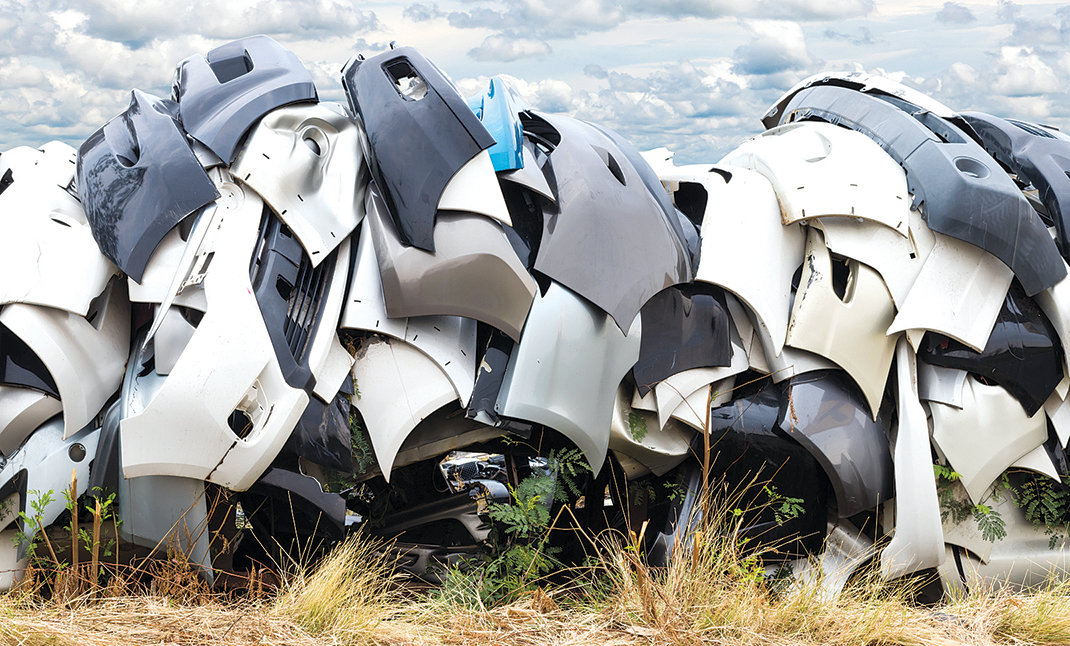
Plastics, glass and automotive fluids – once viewed primarily as waste streams or cost centers – are now emerging as critical components of the next phase of automotive recycling.
Automotive recycling economics have centered on metals like steel, aluminum, and copper, but that’s changing more every year as the auto industry evolves.
Today, however, that long-standing model is beginning to shift as vehicle composition evolves, regulatory pressure intensifies and recyclers are forced to look beyond traditional revenue drivers to remain competitive. Plastics, glass and automotive fluids – once viewed primarily as waste streams or cost centers – are now emerging as critical components of the next phase of automotive recycling, bringing both opportunity and complexity as the industry works to unlock their value.
A Convergence of Change
That shift is not happening in isolation, but rather through a convergence of forces that are reshaping how end-of-life vehicles are evaluated. Increasing material scarcity, evolving environmental regulations and rapid advancements in sorting and processing technologies are all contributing to a new perspective on non-metal materials, even as economic realities continue to present challenges.
“The economics of metal recovery from end-of-life vehicles are well established and remarkably efficient,” said Kari Bliss, principal of sustainability for PADNOS. “Steel, aluminum and copper have liquid global markets, established processing infrastructure and commodity pricing that makes recovery straightforward. Plastics, glass and fluids never had any of that – so they didn’t get the investment.”
What is changing, according to industry leaders, is not just regulatory pressure but the growing ability to actually extract value from these materials. According to Ryan Paterson, chief executive officer of Crush Software Solutions, technology is fundamentally altering what recyclers can recover and how precisely they can do it.
“The technology for recovery is what is driving the ability to recycle more of the material that exists in an end-of-life vehicle,” Paterson said. “There are emerging technologies and techniques that enable recyclers to get more precise in the separation of materials into pure collections that have a real market for recycled parts.”
For instance, the European Union’s End-of-Life Vehicles regulation is a significant catalyst driving this change, requiring automakers to incorporate recycled plastic content into new vehicles – 15 percent within 6 years, rising to 25 percent within 10. “When OEMs face binding recycled content requirements, suddenly the non-metal streams sitting in shredder residue start looking like supply rather than liability,” Bliss said.
The Growing Volume of Non-Metal Materials
Diana Rasner, group lead for materials, chemicals, waste and recycling at Cleantech Group, pointed out that vehicle composition itself is accelerating this transformation, as non-metal materials now represent a substantial portion of modern vehicles.
“Over 50 percent of a vehicle’s volume is non-metal, and that share is growing as manufacturers experiment with lightweight materials,” she said, noting that foam, textiles, dashboards, seats, glass and liners are increasingly common components.
Much of this material still ends up in landfills, but with regulatory frameworks pushing for higher recovery rates and recycled content, the industry is being forced to confront the scale of untapped value embedded in these streams.
Beyond bulk materials, Paterson points to another growing opportunity: automotive electronics. “One of the largest untapped values in recycled vehicles is the electronic control modules that are beginning to show up in yards,” he said. “The average age of a car that enters the self-service recycling yard is approximately 14 years, and those 2012-era vehicles were just beginning to see computers become prolific.”
Those components can carry significant resale value if properly identified and removed. “For instance, the forward-looking cruise control radar in a 2016 Honda Civic currently sells for $350,” Paterson said. “We are beginning to catalog these parts, identify the labor involved in removing them and integrate that into our systems so recyclers can identify and recover high-value components.”
Economic and Behavioral Barriers
Despite these opportunities, unlocking value from non-metals in automotive recycling remains challenging, particularly when it comes to aligning recovery processes with viable end markets. Rasner emphasized that success depends on both technical feasibility and economic viability.
“The biggest near-term opportunities are in materials where recovery is feasible without excessive labor, and where there’s a defined end market or a manufacturer willing to pay a premium for recycled content,” she said.
Paterson echoed this sentiment, noting that the economics of recovery are often the limiting factor rather than the technology itself. “One of the more difficult problems involving plastics recycling in the automotive industry is the economics behind it,” he said. “You need to ensure that the plastic recovered is worth the upfront capital for the equipment required to isolate it.”
Another major challenge lies in the structure of traditional sorting systems, which are often binary. “For every additional material component you look to extract, you have to either rerun material or invest in additional equipment,” Paterson explained, highlighting why many recyclers have historically focused on metals, where returns are more predictable.
At the same time, new technologies are rapidly expanding what is possible. Rasner said the advancement of AI-powered sorting systems can distinguish between resin types with increasing accuracy. “AI-powered sorting is getting significantly better at distinguishing between resin types, which is foundational to any scalable recovery operation,” she said.
Paterson pointed to similar innovations, particularly in plastics recovery. “Sensor-based technologies are becoming more precise in their ability to quickly sort through many different types of materials, including various plastics,” he said. “Polypropylene, polycarbonate, ABS and polyamide can be detected and sorted with AI-based image classifiers.”
Once identified, materials can be separated using mechanical techniques such as air jets, varying belt speeds and density-sensitive systems. “The more precise the separation becomes, the more valuable the material becomes,” Paterson said.
He also highlighted emerging solutions that could fundamentally change the economics of sorting. One example is a system developed by Möbius Industries, which aims to separate multiple material streams in a single pass.
“They envision replacing complex, multi-step sorting lines with a single high-precision machine that can isolate up to five fractions at once,” Paterson said. “This changes the economics for recyclers looking to extract the most value without a massive equipment investment.”
The Challenges of Glass
Glass remains one of the most difficult materials to recycle economically, due largely to both technical and market constraints. “Glass is made from sand, which is abundant and cheap,” Bliss said, making it difficult to justify the cost of recycling without regulatory support.
Compounding the challenge is the laminated structure of automotive glass, which is designed for safety but complicates recycling. “The ability to separate the material before contamination remains a major problem,” Paterson said. “The safety laminations make it difficult to get back to a pure glass substrate.”
Rather than focusing solely on closed-loop recycling, some innovators are exploring alternative applications. “One area where the process can achieve gains is allowing the glass to go into different materials, such as insulation,” Paterson said, noting that this shift in thinking could improve recovery rates.
Fluid Recovery Gains Ground
Automotive fluids, by contrast, represent a more mature segment of non-metal recycling, though their full potential is still evolving. “Fluids are actually one of the more mature non-metal recovery stories in automotive recycling,” Bliss said.
Paterson agrees, noting that many recycling yards already treat fluids as valuable resources rather than waste. “Yards have very specific processing areas for removing all of the fluids, including Freon,” he said. “You’re very likely to find recycled windshield washer fluid and engine coolant available for resale.”
Recovered fuels can also be reused internally or even sold, depending on regulations. “Gasoline and diesel are filtered and purified and then used to power the machinery of the yard or given to employees,” Paterson said. “In some cases, operations can sell recovered fuel to the public at a significant discount.”
Oil recycling, meanwhile, has been established for decades. “We were recycling used oil back in the 1980s,” Paterson said. “It’s filtered, decontaminated and repurposed for a wide range of products.”
Finding Economic Parity
Achieving economic viability for non-metal materials will require coordinated progress across multiple areas. Bliss pointed to the need for demand signals, infrastructure investment and realistic economic expectations.
Paterson framed the challenge slightly differently, emphasizing that non-metals do not need to match metals in value but must become more predictable and scalable. “I would not frame it as needing to be as valuable as metals,” he said. “For non-metals to get closer economically, several things have to happen.”
Those include capturing materials before contamination, reducing labor costs through automation, establishing reliable quality metrics and strengthening end-market demand. “The more predictable the quality and the buyer, the more financeable the recovery process becomes,” Paterson said.
While recycled non-metal materials are likely to remain more expensive than virgin alternatives, regulatory pressure and corporate sustainability commitments are beginning to shift the equation.
Looking ahead, the role of non-metal materials in automotive recycling is expected to expand significantly as both technology and market demand continue to evolve. “My experience has been that the recycling community will continue to try to extract every piece of value out of the vehicles that enter the recycling stream,” Paterson said.
As these materials become viable profit centers, their recovery will become standard practice rather than an exception. Regulations may accelerate adoption, but long-term success will depend on making recovery both efficient and economically attractive.
For recyclers, the implications are clear. Those who invest in the capability to recover, process and market non-metal materials will be better positioned to meet the demands of automakers and regulators alike. As Rasner noted, “the industry that doesn’t develop non-metal recovery capabilities will increasingly be leaving value on the table or facing regulatory penalties.”
by MAURA KELLER
mkeller@americanrecycler.com
Published May 2026