

Manufacturer
Bano Recycling s.r.l. BCA Industries CM Shredders Eagle International Eco Green Eldan Recycling Franklin Miller Inc. Gradeall International Ltd Granutech-Saturn Systems, Inc. M&J Recycling Recycling Equipment Inc. SSI Shredding Systems, Inc. Untha America Zato North America |

by MARY M. THORNTON
maryt@americanrecycler.com
Rubber recycling plays a vital role in environmental sustainability by reducing the accumulation of non-biodegradable waste in landfills and minimizing the environmental impact of tire disposal. The global scrap rubber market size is projected to reach the $6.18 billion mark by 2033, according to Business Research Insights. The market is progressively embracing the principles of the circular economy. Manufacturers and governments are advancing in reducing waste and expanding operations to include the recycling of discarded tires so that fresh products and materials are the end result. These advances reduce dependency on raw rubber and contribute to environmental sustainability. By closing the loop in the tire lifecycle, waste and landfilling is reduced and the need for fresh resources is mitigated. This aligns with a more eco-conscious and resource-efficient practice, benefiting both the environment and the economy. Whether involving scrap rubber or other recycling processes such as tire-derived fuel production, there are many equipment options available for converting the material and downstream applications.

Eldan Recycling
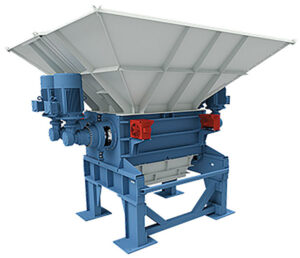
Shredders manufactured by Eldan Recycling are used to reduce waste size, facilitating easier handling and further processing. A leading manufacturer of recycling equipment, Eldan specializes in shredders designed for a range of waste materials. For instance, the tire shredder plant (A-plant) transforms whole tires into shreds, ranging from 50 to 300 mm, which can be further processed into chips or granulate. “Eldan’s equipment is known for its durability, ease of maintenance, and adaptability to various waste streams,” Carsten Nielsen, product manager, stated.
Eldan’s Twin Shaft Clean-Cut Shredder produces uniform shreds, ideal for tire-derived fuel applications. The company’s product line also includes the Super Chopper, Multi Chopper and Ring Shredder. Each product is tailored for specific applications. These machines are integral to Eldan’s modular recycling plants, which process tires, cables, e-waste, and municipal solid waste. The Super Chopper is renowned for its high capacity and versatility, capable of processing up to 8 tons per hour and is particularly effective for pre-shredding large volumes of waste. The Multi Chopper offers flexibility for smaller operations, while the Ring Shredder is designed for fine shredding ̶ an essential part of e-waste recycling, to liberate valuable metals.
Setting up these systems requires careful planning, including material sampling and customization to meet specific input types and desired output fractions. Eldan provides comprehensive support during installation and operation to ensure optimal performance.
Nielsen commented, “The recycling industry is experiencing a shift towards more sustainable practices, with increasing demand for efficient waste processing solutions. Eldan stays ahead by continuously innovating the technology involved in their products, to meet evolving regulatory standards and client needs. Established in 1956, Eldan’s commitment to quality and customer support positions us as a reliable partner in the recycling sector.”

Franklin Miller Inc.
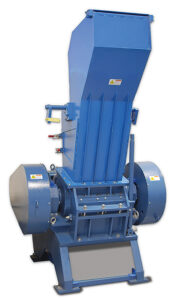
The VULCANATOR® Rubber Granulator manufactured by Franklin Miller is a specialized solution designed to efficiently reduce large rubber bales into fine granules, and is used in the recycling, automotive and manufacturing industries. Capable of processing 75 lb. bales of synthetic or natural rubber, the Vulcanator handles various material types, including vulcanized and non-vulcanized rubber, sheets and chips.
A standout feature of the Vulcanator is its low-friction cutter design, which minimizes heat generation during operation. This eliminates the need for additional cooling systems, preserving the integrity of heat-sensitive materials and reducing energy consumption.
The granulator operates by feeding rubber into the unit – either manually or via conveyor – where rugged rotary knives pull the material into the cutting area. The rubber is then disintegrated into smaller particles that pass through a sizing screen, ensuring uniform granule size suitable for various applications. Franklin Miller offers the Vulcanator in two models to accommodate different processing needs: The KM10 is equipped with a motor size up to 60 HP (45 kW). This model is versatile, handling materials like rubber, vinyl, and plastic, also making it suitable for various industrial applications. The KM30 features a robust 150 HP (110 kW) motor and is tailored for heavy-duty rubber processing, efficiently reducing full bales to desired output sizes.
Constructed with heavy duty fabricated steel and a split-body design, the Vulcanator allows easy interior access for maintenance. Optional features include stainless steel construction, pneumatic discharge and liquid seals, enhancing its adaptability to specific operational requirements. “By integrating the Vulcanator into your operations, you can achieve significant reductions in processing time and costs, while ensuring high-quality granulated rubber output suitable for various end-use applications,” said Garrett Pasono, marketing manager.

Granutech-Saturn Systems, Inc.
According to Greg Wright, vice president of Granutech-Saturn Systems, “Tire recycling is a large segment of our business and we manufacture equipment for all stages of tire recycling – from the primary shredder to fine grind refiner mills and everything in between. Tire derived fuel is a large segment of scrap tire recycling and other segments, including rubberized asphalt, sports turf crumb and rubber mulch. The science behind pyrolysis continues to advance as well.
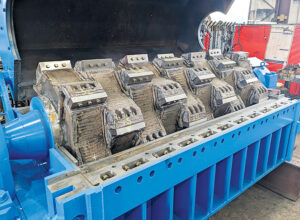
Granutech offers over 50 years of manufacturing experience in size-reduction equipment. Added Wright, “The equipment we manufacture and recommend for tire recycling can vary greatly, depending on the customer’s requirements. Depending on the final product size required, processing rates can range anywhere from one ton per hour up to 20 tons per hour. If a customer only wants to make a primary shred or a chip, we would recommend one of our dual shaft shredders, possibly with an external sizing screen, or a quad shaft shredder. If the goal is to reduce tires to a powder, then four stages of processing with various pieces of equipment at each stage are involved, performing various tasks. Reducing tires to crumb rubber is much different than performing a primary shred or chip, as removing the steel and fiber becomes a large part of the process at different stages and with a variety of equipment.”
Published in the August 2025 Edition of American Recycler News