

Manufacturers
Bunting Magnetics Dings Company Magnetic Group Ecohog Ltd. Eriez Manufacturing Co. IMRO Maschinenbau GmbH Magnapower Equipment Ltd. Magnetic Products, Inc. SGM Magnetics Spaleck USA LLC Steinert US |



by MARY M. THORNTON
maryt@americanrecycler.com
As this publication has chronicled throughout the year, metal recovery, precious and otherwise, has never been more important – not just to reduce the landfilling of commodities, but so these materials are recycled. The following companies can provide ECS machines, along with helpful advice and support as well.
Bunting’s eddy current separators are trusted by material recovery facilities worldwide and the firm’s ECS technology includes both concentric and eccentric rotor designs, tailored to match a wide range of applications. Each system is built around a high-speed magnetic rotor within a non-metallic shell, engineered to repel aluminum, copper and other nonferrous metals away from material flow for clean separation. “What sets Bunting apart is its deep commitment to application-specific solutions. Recycling is not one-size-fits-all. From mixed plastics with embedded metals to shredded automobile residue, the variation in particle size, shape and composition requires tailored magnetic field strengths, pole configurations and rotor speeds. Bunting’s experts work closely with each customer to evaluate plant goals such as metal purity, recovery rate, and throughput then fine-tune the ECS accordingly, said Mark Friesen,” global marketing director.

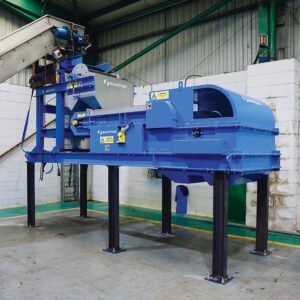
Bunting Magnetics
He added that this is backed by in-house testing at Bunting’s material test centers, where real-world conditions are replicated to ensure optimal performance before installation. It is a hands-on, engineering-first approach that builds confidence and minimizes operational surprises. “For recycling companies, the result is more than a machine. It is a dependable, high-efficiency tool that helps drive profitability, sustainability, and compliance every single day. Contact us to learn how we can optimize your metal recovery process,” stated Friesen.
“When it comes to nonferrous metal recovery such as aluminum, copper and brass, we have eddy current models engineered for every process,” noted Steve Tanzilo, Dings Co. Magnetic Group sales manager. He described how, as material passes over an ECS, the magnets inside rotates at a high speed and the resulting polarity causes material to be repelled away from the magnets. This repulsion makes the trajectory of the ferrous material greater than that of the nonmetallic material, the two materials are separated and two material streams are created.

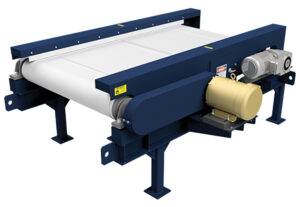
Dings Company Magnetic Group
“Our ECS products are available in concentric and eccentric versions. The 9100, our most economical ECS, is ideal for recovering aluminum cans and other smaller sized nonferrous metal. The 9500 is a heavy-duty ECS, designed for larger nonferrous and higher throughputs. Both models employ a triple layer rotor shell design. The outermost layer is ceramic tile attached to a fiberglass substrate. Inside, a heavy duty, stainless steel, inner shell protects the rotor assembly, reducing maintenance and replacement costs. It is manufactured with a heavy duty, structural steel I-beam frame and support structure, oversized shafts and bearings and a heavy-duty drive package,” Tanzilo said.
The 9900 eccentric model is specifically engineered to remove nonferrous from fractional sizes up to aluminum cans, from mixed material streams. The rotor’s off center “eccentric” magnet design allows ferrous metal that made it past the upstream magnetic separator to be released from the belt as it leaves the rotor’s magnetic field. This reduces the likelihood that ferrous metal will cling to and damage the belt and shell, extending rotor life. Tanzilo concluded, “Our Eccentric ECS, with a double shell layer design, provides maximum protection of the rotor assembly while significantly reducing overall maintenance and replacement costs. The Eccentric model, built on a heavy-duty steel cantilevered frame with removable access panels, makes maintenance and removal of the polyurethane or nitrile wear-resistant belt, easier and faster.”
Blake Brown, sales director, explained the uniqueness of the Spaleck EC 380 Tracked Mobile Eddy Current Separator as “a true game-changer. With precision and power, this unit meticulously separates valuable commodities, ensuring they’re not only recovered but also remarkably free from unwanted contaminants.” He added that this purity level is a direct pathway to higher-value end products, reduced processing costs and a significant boost to the circular economy. The combination of its robust drum magnet and advanced eddy current rotor creates a magnetic field that ejects nonferrous metals with astonishing accuracy.

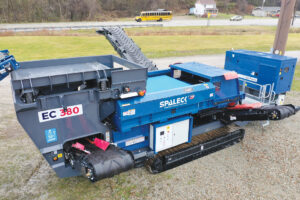
Spaleck USA LLC
“What truly sets the Spaleck EC 380 apart is its inherent mobility. It is a nimble, tracked champion capable of traversing diverse terrains with ease, whether operating on a sprawling landfill, a bustling construction and demolition site, or a remote processing facility. This ‘bring the machine to the material’ capability eliminates costly, time-consuming material transport and dramatically improves logistical efficiency and overall project timelines. The EC 380 provides quick setup and breakdown, maximizing uptime and performing exactly when and where it’s required,” Brown commented.
The machine also offers operational sustainability with an electric drive, powered either by an integrated onboard generator or direct mains supply. The result is lower emissions, reduced fuel consumption and quieter operation – benefitting the environment and operators. Paired with intuitive controls and real-time adjustable splitter systems, the Spaleck EC 380 is powerful and user-friendly and so is useful in a wide range of operations.
Brown concluded, “More than just an investment in superior material recovery, operational agility and a cleaner future, the 380 unlocks the true value hidden within waste. It allows users to transform waste into pure resources, thanks to a versatile platform that works wherever it is needed. The future of mobile metal separation is here, and it’s driven by Spaleck.”
Adam Floyd, process and business development director of Orbcon, noted “Our IMRO machines process high volumes and are shipped from our manufacturing facility in Germany and U.S. Orbcon distribution centers. With a 44 pole high frequency and an up to 100’’ width, the IMRO RCSX F-240 Condor eddy current recovers nonferrous metals of even 0.5 mm. This ECS spins at 3,800 rpm and is equipped with a patented horizontally and vertically adjustable electrical divider with memory function.”
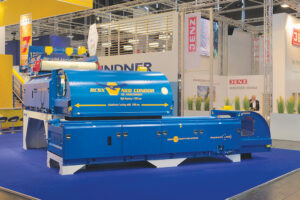
IMRO Maschinenbau GmbH
Floyd added that properly sized material greatly improves ECS performance. It is important to maintain a 3:1 size ratio (or smaller) between particles and other important ESC factors are “magnetic strength/gradient, frequency, as well as the gap between the magnets and the material being processed. IMRO’s proprietary technology utilizes carbon fiber instead of stainless steel, which drastically minimizes such gaps and differentiates our products from others.”
Proper maintenance is important for ECS longevity, Floyd also said. A typical ECS life span is about 15 years when properly maintained. IMRO recommends that at the 12 to 15 year mark, checking the Gauss reading on the pole drum of a machine, to confirm the strength of the magnetic circuits. Exposure to high and seasonal fluctuating temperatures over time can affect the strength of the magnetic fields of an EC.
Floyd stated how “eddy current use helps reduce CO2 emissions and can greatly benefit MRF, RDF, e-scrap, IBA, ASR, metallurgical slag and wood processing, glass, plastic and textile recycling operations.”
Published in the December 2025 Edition of American Recycler News