























Manufacturers
Bay Plastics Machinery Buskirk Engineering CPM ECON GmbH Erema North America Greenmax/Intco Recycling KrauseMaffei Group GmbH Maag Group NGR GmbH |

by MARY M. THORNTON
maryt@americanrecycler.com
Recycling plastic waste through pelletizing enables users to transform discarded plastic into pellets that can be used as raw material for other products or applications. Instead of sending plastic waste to a landfill, pelletizer machines convert it into valuable material that can be reused or sold, creating a potential source of revenue for the operator. The companies below manufacture equipment that serves many types of plastic recyclers, across the globe.
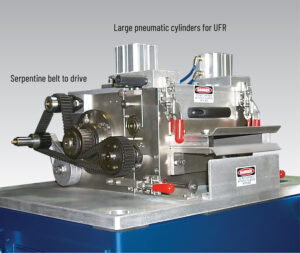
Bay Plastics Machinery (BPM) provides strand pelletizing systems designed to meet the diverse production requirements of plastics recyclers and compounders processing virtually any thermoplastic material. Products range from laboratory-scale pelletizers that process a single strand at less than one pound per hour to large production systems capable of handling up to 250 strands and throughput rates exceeding 10,000 pounds per hour.
Bay Plastics Machinery
Among BPM’s most popular products is the AXP Series Strand Pelletizer. Available with cutting chamber sizes from 4 to 16 inches, the AXP Series can process up to 80 strands and is designed to convert extruded plastic strands into uniform pellets for packaging, handling and downstream manufacturing operations. “This pelletizer is known for its rugged construction, ease of operation, and low-maintenance design. Tool-free access to key components simplifies cleaning and servicing, while a dual-bearing rotor support system enhances stability and durability in demanding production environments,” Jim Forgash, vice president of sales, explained.
To improve productivity and reduce operating costs, BPM developed proprietary wear technologies that extend component life and minimize maintenance requirements. The InduraMaxx® upper feed rolls are manufactured from a specially engineered material that delivers superior wear resistance and performance at elevated operating temperatures. Complementing this technology is BPM’s InduraCut™ carbide blade system, which utilizes a proprietary carbide formulation optimized for rotor and bed knife applications. Both products can help increase uptime and reduce maintenance frequency.
With roots in this technology originally developed by JETRO Inc., a pioneer in strand pelletizing, BPM’s SMART control system provides enhanced process monitoring. This helps operators to maintain consistent pellet quality while supporting the evolving needs of modern plastics processing.
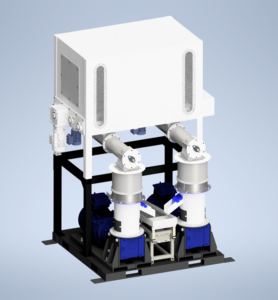
Adolfo Porrata, Buskirk plant manager said, “The most efficient plastics recycling takes place during the manufacturing process, minimizing waste handling costs. Our pellet mill is easily embedded into a process to automatically create production tailings in pellet form. Pelletized post-consumer waste – including plastics, can also be resold for use in furniture manufacture. Be it recycled plastics, pellet-fired furnace fuel, densified biomass animal feed, or bulk-reduced and sterilized solid waste for fertilizer, we produce our pellet-mills to perform the pelletizing function seamlessly.”
Buskirk Engineering
Buskirk builds virtually all associated pieces of equipment to provide customers with a fully-functioning, turnkey pellet production system. Whether the customer is a small, entry-level user or a mid-size through industrial-level operation, a system is engineered and scaled to meet customer needs.
For a manufacturing company that had nearly 30,000 square foot of storage space set aside for regrinding waste, trim and off spec plastic products, Buskirk provided a pelletizing system that allowed the customer to emulate their original raw material. Previously, the client could only blend 20 percent of regrind into raw material. Buskirk Pellets improved efficiency and greatly reduced processing and storage space requirements.
“We stand behind our quality, whether it is the materials used or the workmanship we incorporate. Regardless of where you are located, we ship not just our equipment but replacement and spare parts, to every corner of our distribution area. If it is not in inventory, production stands ready to replace the part to meet our customer’s schedule needs. The best testimony of our quality is the rate of growth supported by returning customers and their referred associates across the industries into which pellet production continues to expand,” Porrata concluded.
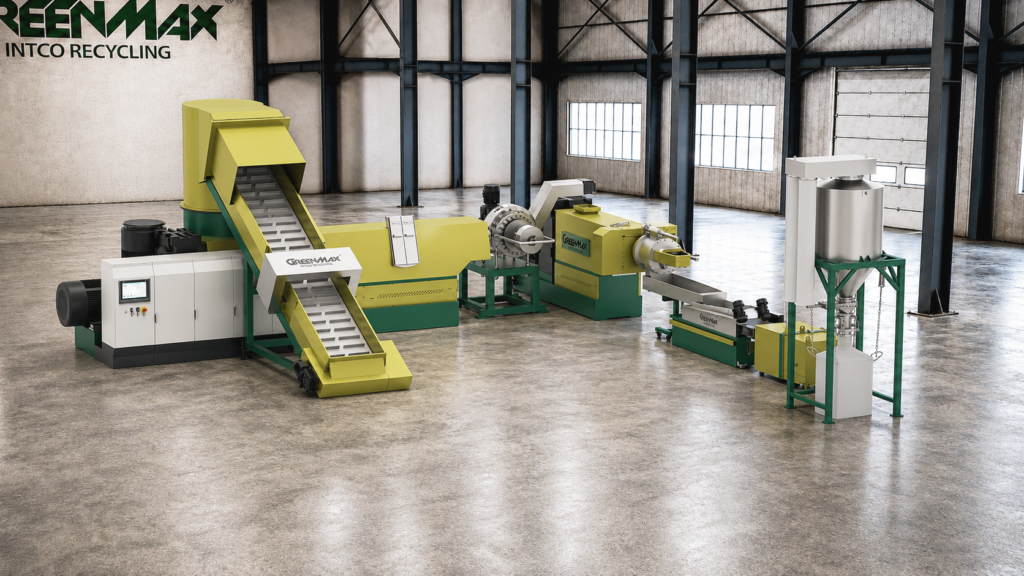
INTCO Recycling manufactures GREENMAX plastic recycling equipment, including plastic pelletizing systems designed to convert recovered plastic materials into reusable pellets for downstream manufacturing. GREENMAX pelletizing solutions can be configured for different plastic streams, including post-consumer and post-industrial materials such as EPS, EPE, EPP, PE, PP and other recyclable plastics, depending on material condition and customer requirements. The systems are typically used after proper sorting, crushing, washing, drying or densifying, helping recyclers transform loose or bulky plastic waste into a more uniform recycled raw material. Key features include stable extrusion performance, user-friendly operation, durable construction, efficient material feeding and flexible system layouts for varied facility needs, including: recycling plants, packaging waste processors and manufacturers with in-house scrap and companies seeking to improve the value of recovered plastic.
One of the main challenges for users is that plastic waste often varies in moisture level, contamination, size, density and melt characteristics. These factors can affect pellet quality and production stability. For many operators, successful pelletizing begins before the pelletizer itself, with proper material preparation and consistent feeding. GREENMAX helps customers evaluate the full recycling process, including size reduction, drying, densification, extrusion and pellet cutting, so the equipment can match the material type and expected processing volume. Training, maintenance access and reliable technical support are also important for reducing downtime and improving long-term performance.
Greenmax/Intco Recycling
Byron Gu, marketing manager, noted how the market for plastic pelletizing equipment continues to grow as companies look for practical ways to reduce landfill disposal, lower raw material costs and support circular economy goals. “Demand is being driven by higher interest in recycled-content products, corporate sustainability programs and regulations that encourage plastic recovery and reuse. Customers are also paying more attention to automation, energy efficiency, pellet consistency and the ability to process challenging plastic waste streams.
INTCO Recycling’s advantage is its long-term experience not only as an equipment manufacturer, but as a recycler and recycled product manufacturer. This background allows GREENMAX equipment to be developed with real production needs in mind. By helping customers turn plastic waste into valuable recycled pellets, GREENMAX supports a more efficient and commercially viable recycling process.”
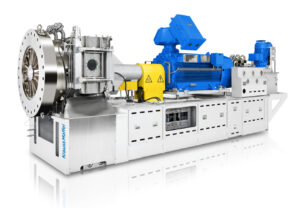
As polymer producers increasingly prioritize throughput, energy efficiency and operational reliability, advanced pelletizing technology has become a decisive competitive factor in modern extrusion lines. The Underwater Pelletizer from KraussMaffei Extrusion “addresses these requirements with a solution specifically engineered for demanding LDPE, EVA and POE applications, combining high production capacity, limited maintenance demands and consistent pellet quality,” commented Tim-Keke Umlauf, product manager petrochemical.
KraussMaffei Extrusion has been supplying underwater pelletizers since 1961 and today supports customers with processing volumes of approximately 100 up to 500 KTA per year. The company’s current underwater pelletizer portfolio covers sizes from 50 to 80 and achieves average throughputs ranging from 20 to 60 t/h, depending on melt index and individual customer specifications. Higher throughput capacities can be provided upon request. Usually, the pelletizer is combined with the KraussMaffei Extrusion KE single-screw extruder.
KrauseMaffei Group GmbH
A key differentiator of the system is its unique cutting concept for LDPE, EVA, and POE applications. Unlike conventional “direct contact cutting” technologies, the KraussMaffei pelletizer operates with a defined gap of 0.05 to 0.1 mm between the knife and die plate. This is enabled by rigid knife heads that are precisely aligned to the die plate, while flexible knife hubs for contact cutting remain available as an option.
The benefits are substantial. Knife lifetime can increase to up to 12 months, compared with an industry average of approximately three months, significantly reducing maintenance intervals and production stoppages. Die plate lifetime is also extended, contributing to lower overall operating costs. Furthermore, the use of less heat-conductive hard facings such as titanium carbide improves thermal balance within the die plate. Combined with a 2:1 row design and heating channels positioned close to the die holes, the system ensures more uniform melt heating and enhanced pellet quality while less heat is transferred to the cooling / transport water.
“As current market trends are continually shaped by growth in the solar energy sector and the expanding plastics recycling market, KraussMaffei Extrusion continually develops recycling technologies to address evolving sustainability requirements across the polymer industry,” stated Umlauf.
Published in the September 2026 Edition of American Recycler News