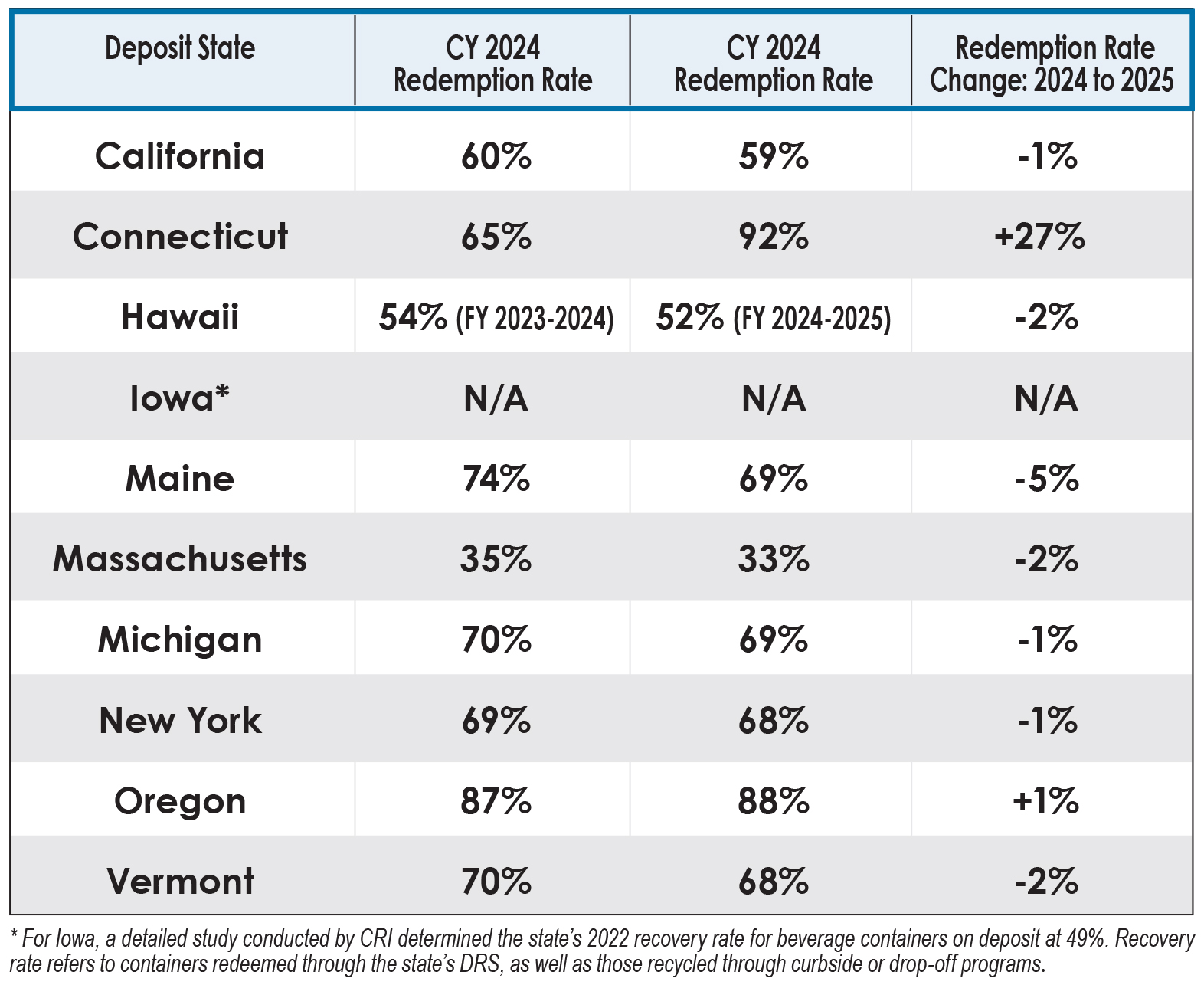

CRI president Susan Collins said that DRS programs represent the “gold standard” for increasing beverage container recycling rates, with containers on deposit recycled at a 64 percent rate in the U.S. and containers not on deposit at 26 percent (2021 data). She added that given the decade-long decline in redemption rates in several DRS states, program maintenance and modernizations – higher container deposit amounts, coverage of more beverage types, additional convenient options for bottle and can returns and enforcement of program requirements – remain the best practices for long-term increases in redemption rates.
Based on legislation that placed deposits on more beverage types in California (starting in 2024) and Connecticut (starting in 2023), CRI can conclusively say that 2 billion-plus more beverage containers are now on deposit in the U.S. compared to just a couple of years ago.
Redemption of more containers on deposit is crucial to ensuring a greater supply of clean, high-quality material for manufacturing new products. State DRS Program Improvements Collins also pointed to positive developments in several DRS states. “Maine and Vermont earn kudos for working to implement DRS program overhauls to lay the groundwork for future program upgrades, while California receives credit for expanding beverage container redemption options for consumers, which CRI had advocated for over the course of seven years,” she said. “The redemption rates in Massachusetts (a troubling deposit state low of 33 percent) and Michigan, both of which have lagged in making any program improvements, have dropped the most among DRS states since 2019 – 17 percent and 20 percent, respectively,” she noted. “This provides a clear indication of the importance of legislative and regulatory action to stabilize and ultimately increase redemption rates.”
Connecticut
A 27 percent Redemption Rate Increase Signed into law in 2021, Connecticut’s SB 1037 was the most significant DRS expansion – modernization legislation passed in the U.S. in about a decade. Its phased-in implementation of improvements included: 1) raising handling fees for retailers and redemption centers to cover increases in operating costs (effective October 1, 2021); 2) requiring chain stores that meet certain criteria to provide at least two reverse vending machines (RVMs), effective October 1, 2021, which added 300 new redemption sites for consumers; 3) placing deposits on non-carbonated beverages and malt-based hard seltzer (effective January. 1, 2023); and 4) increasing the deposit-refund for covered beverages from 5¢ to 10¢ (effective January 1, 2024).
California
The Golden State continues to roll out provisions included in legislation (SB 1013) and budget bill AB 179, both signed into law in 2022, that authorized more than $1 billion in spending on its DRS program. This includes funding via nearly a dozen grants for new redemption centers, RVMs, mobile recycling, bag drops and high-volume counting equipment. However, not all of the legislative provisions specifically address greater consumer access to redemption centers.
CRI will continue to advocate for the need to maximize use of program monies to restore availability of redemption centers lost over time, given that half of the state’s centers closed from 2013 to 2022.
California also added deposits on wine and spirits effective January 1, 2024 and closed a program loophole by adding coverage to 100 percent fruit and vegetable juices in larger sizes than previously included.
Not all DRS legislation receives the visibility California’s has. But Collins noted that in Maine and Vermont, legislative developments are overhauling the states’ DRS program structures to establish a smoother path toward larger program modernizations moving forward.
Maine
Simplified Container Sorting at Redemption Centers LD 1909, signed into law in 2023, mandates creation of a “commingling cooperative” of brand owners to coordinate the pickup of and payment for redeemed containers; and to establish a plan to simplify and optimize the redemption center container sorting process. Effective July 15, unredeemed deposits are now the property of the cooperative to fund DRS program improvements instead of going back to beverage companies. And by October 1 of this year, brand-level sorting (typically requiring hundreds of bins) will shift to material-type sorting to streamline the process for redemption center employees, lower center costs and increase the DRS program’s overall efficiency.
Vermont
A Producer Responsibility Organization Stewardship Plan signed into law June 17, H.915 took effect July 1, with an immediate 1¢ increase in the handling fee for redemption centers to support their financial viability.
Other key provisions include formation of a Producer Responsibility Organization (PRO) by January 1, 2027; an April 1, 2028 deadline for submittal of a PRO stewardship plan to the state; and implementation of the PRO stewardship plan by March 1, 2029.
As part of efforts to ensure consumers have convenient beverage container redemption options, the plan must include at least three redemption points per county. Collins said that the number of bills introduced on new and expanded state DRS programs continues to increase. She added, “We know that DRS programs work. The interest is there and progress is occurring on several fronts, though it doesn’t always get enough attention. CRI will continue our original research, objective analysis and responsible advocacy to support the passage of legislation that establishes successful DRS programs and provides effective upgrades to current ones – a vital way to benefit industry, consumers and the environment.”
Published August 2026