































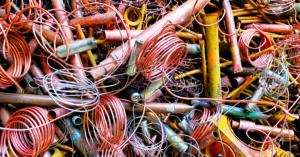
Copper theft can disrupt operations, damage vehicles, create safety concerns and impact the ability to efficiently process vehicles and recover valuable materials.
Copper theft has long been a challenge across the recycling industry, but for recyclers, the issue has become increasingly complex. As the value of copper remains high and criminals look for accessible sources of valuable metals, vehicle processing facilities are facing greater pressure to protect inventory, improve traceability and strengthen security practices.
For recyclers, copper theft is not only about the loss of a commodity. Theft can disrupt operations, damage vehicles, create safety concerns and impact the ability to efficiently process vehicles and recover valuable materials.
“Copper theft has become much more than a scrap metal issue,” said Steve Reinharz, chief executive officer of AITX and its security technology subsidiary, RAD. “Today, it’s an operational disruption issue.”
While copper prices continue to influence theft activity, Reinharz said the larger concern is how easily valuable materials can be targeted at locations where monitoring is limited.
“The value of copper certainly plays a role. When prices rise, theft becomes more attractive,” he said. “But what we’re seeing now is that the targets have expanded.” For recyclers, that means protecting large outdoor yards, vehicle storage areas, processing zones and material inventory from criminals looking for opportunities.”
Sean Mee, senior director of solution engineering at Verkada, said the economics behind copper theft have remained consistent for decades.
“At its core, copper theft has always been fundamentally an economics problem – you have a commodity with high resale value, combined with a low barrier to entry and very little traceability,” Mee said.
However, he said the biggest change is not necessarily that thieves have become more sophisticated. Instead, criminals are taking advantage of locations where security gaps exist.
“Most targets are picked because they are ‘soft’ – unmanned, after-hours sites where detection doesn’t happen until the next morning when someone finds the damage,” Mee said. “The security technology to close that gap now exists, but adoption is still catching up.”
Understanding the threat
Recyclers have always operated in an environment where valuable materials are stored, processed and moved daily. Copper-containing components, wiring, electrical systems and other vehicle materials can become targets for theft once vehicles enter a salvage yard.
Criminals often look for materials that combine value, accessibility and ease of removal.
Joe Morgan, segment development manager – critical infrastructure – Americas at Axis Communications, said thieves typically target copper that can be accessed quickly.
“They know where they can quickly cut and remove valuable material, which is then sold through a network of buyers, including black-market operators and non-reputable recyclers or smelters,” Morgan said.
While Morgan’s experience is focused heavily on critical infrastructure, the same challenge applies to auto recycling operations: once stolen material leaves the original location, tracing its path becomes much more difficult.
“What starts with a single theft can quickly become difficult to trace as the copper moves through several intermediaries before ultimately entering the recycling stream,” Morgan said.
Reinharz said the most significant challenge is that recyclers often encounter stolen material after the initial crime has already occurred.
“By the time stolen material reaches a recycling facility, the theft has already occurred and the damage has already been done,” he said.
For recyclers, preventing theft before materials leave the yard is becoming a greater priority.
“The goal is no longer just identifying stolen material after the theft occurs,” Reinharz said. “The goal is preventing the theft from happening in the first place.”
Strengthening intake and verification
Recyclers have increasingly invested in stronger intake procedures to create better visibility into where materials come from and who is selling them.
Seller identification, transaction documentation, digital records, video monitoring and communication with law enforcement are becoming important tools for legitimate recycling operations.
“Many operators now require seller identification, maintain detailed transaction records, utilize video documentation, monitor transaction patterns and work more closely with law enforcement and industry partners when suspicious activity is identified,” Reinharz said.
Mee said one of the biggest improvements has been moving away from manual records and toward searchable digital information.
“The biggest shift I see at intake is from paper logs to searchable digital records, paired with camera coverage and license plate capture at the gate,” he said. “The technology lets a facility tie a seller, a vehicle and a transaction together in a way that’s actually ‘queryable’ later.”
For recyclers, that ability can be especially valuable in an environment where hundreds of vehicles, sellers and transactions may move through a facility.
However, Morgan said technology only works when facilities actively use it.
“The technology to verify and identify potentially stolen copper exists, but the real issue is who is actually using it,” he said. “While honest businesses and investigators lean on these tools to identify criminal activity, black-market operators intentionally ignore them to stay under the radar.”
Moving beyond cameras to active security
Historically, security cameras were used primarily as a tool for reviewing incidents after they happened. Today, new technologies are shifting the focus toward preventing theft before it occurs.
“Advanced security technology plays a critical role in preventing and deterring copper theft,” Morgan said. “Technologies such as AI-powered video surveillance, license plate recognition and third-party real-time monitoring can help identify and respond to theft as it occurs.”
AI-powered systems can monitor activity across large auto recycling facilities, identify unusual behavior and alert operators when something appears out of place.
“The real shift I see is from systems that record a theft, to systems that detect it and alert as it is actually happening,” Mee said. “After-hours person-or-vehicle detection that triggers a response, rather than footage you review the next day.”
For recyclers, this can be especially valuable because large salvage yards can be difficult to monitor continuously with employees alone.
Mee said license plate recognition technology also provides greater accountability.
“When you can log every vehicle and search that data on demand, moving stolen material anonymously gets much harder,” he said. However, he cautioned that technology must be part of a larger security strategy.
“Detection without a defined, rapid response is just ‘admiring the problem,’” Mee said. “Bolt AI onto a fragmented stack of disconnected cameras and access systems and it can’t actually get the inputs it needs.”
Morgan said tools such as network speakers and lighting can provide additional deterrence.
“Additional deterrents, such as network speakers and LED lighting, can further discourage criminal activity in the moment,” he said. “These systems can deliver pre-recorded messages or enable live operators to issue real-time voice warnings when individuals enter restricted areas or exhibit suspicious behavior.”
Balancing security with yard operations
One of the biggest challenges for recyclers is implementing security measures without slowing down the fast-moving nature of their businesses.
Large yards process significant volumes of vehicles, manage customer interactions and coordinate material movement. Any security system must support efficiency rather than create unnecessary delays.
“One of the biggest challenges is balancing security with throughput,” Reinharz said. “Recycling facilities exist to process material efficiently, and many handle a significant volume of transactions, deliveries and customer interactions throughout the day.”
Mee said technology must be practical for employees to use.
“At a high-throughput facility, anything that adds friction to intake gets worked around or switched off, so the technology has to be fast and largely automated,” he said.
He said one common challenge is what he called “integration debt” – the issue of facilities adding security tools over time that do not work together.
“Facilities add cameras and systems piecemeal over years, from different vendors, that were never designed to talk to each other,” Mee said. “Then they try to layer AI on top and discover the foundation can’t support it.”
The most effective approach, he said, is treating security as part of an overall operational strategy.
“The common mistake is treating security as a shopping list of products instead of thinking through the larger strategy of how to integrate these separate systems,” Mee said.
Collaboration and traceability
Because metal theft affects the entire recycling ecosystem, industry experts said stronger collaboration among recyclers, law enforcement and other stakeholders is essential.
Morgan said many investigations begin only after a theft occurs.
“Most of the time collaboration is done after the fact,” he said. “Recyclers, law enforcement and utilities come together after a crime occurs to figure out how much material was stolen, who the thief is supplying and where the product is going.”
The opportunity, he said, is using technology to intervene earlier.
“Those who want to catch thieves want to catch them in action, which is where analytics come into play,” Morgan said. “Analytics can help identify criminal behavior in real time or stop a theft before it occurs.”
Reinharz said stronger collaboration is already developing because no single organization can solve the issue alone.
“Utilities, construction companies, telecommunications providers, recyclers and law enforcement all experience different parts of the same problem,” he said.
For recyclers, that collaboration can include sharing information about suspicious transactions, improving documentation practices and working with law enforcement when patterns emerge.
The future of copper theft prevention
Looking ahead, experts expect the next generation of security technology to focus on combining artificial intelligence, automation and data sharing. Morgan said technologies such as thermal cameras, access control, drone detection and advanced analytics will play a greater role in protecting vulnerable areas.
“The organizations that will see the greatest success in reducing theft are those that pair real-time analytics with active deterrence,” he said.
For recyclers, protecting copper and other valuable materials will require a combination of strong operational practices, better documentation, collaboration and technology that helps identify threats before losses occur.
“The future isn’t about creating more alerts or collecting more data,” Reinharz said. “It’s about turning information into action quickly enough to prevent losses, protect operations and make it increasingly difficult for theft to succeed.”
by MAURA KELLER
mkeller@americanrecycler.com
Published August 2026