

















































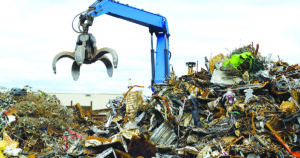
A powerful combination of manufacturing reshoring, infrastructure investment and sustainability initiatives are reshaping the U.S. scrap recycling industry.
For decades, the U.S. scrap recycling industry has operated within a global marketplace, balancing domestic consumption with export opportunities. Today, however, a powerful combination of manufacturing reshoring, infrastructure investment and sustainability initiatives are reshaping the landscape. Increasingly, domestic scrap is being viewed not simply as a commodity, but as a strategic resource critical to supporting American manufacturing, construction and energy development.
As manufacturers bring production back to the United States and federal investments fuel large scale infrastructure projects, demand for ferrous and nonferrous scrap is rising. At the same time, recyclers, processors, mills and foundries are adapting to changing quality requirements, supply chain dynamics and long-term market expectations.
Manufacturing Returns Home
The movement to reshore manufacturing operations has become one of the most significant factors influencing scrap demand. Brad Serlin, president of United Scrap Metal, said investments in domestic metal production are helping support supply chains that increasingly require shorter lead times and greater reliability.
“The reshoring impact continues to present an optimistic future for the scrap recycling industry,” Serlin said. “Investments in domestic metal production, to fulfill the needs of reshoring by having the ability to create finished sheet, plate, bar, tube and extrusions, is a critical factor within the supply chain.”
According to Serlin, automotive, electrical and housing-related supply chains are among the sectors driving the transition from overseas production to domestic manufacturing.
Loretta Clark, vice president of North America Metals & Minerals Research at Industrial Info Resources, believes the shift extends beyond simply relocating factories.
“Reshoring is fundamentally shifting domestic scrap from a traditional export commodity to a high-value domestic asset,” Clark said. “As manufacturing capacity returns to the U.S., we are seeing a structural push for localized closed-loop recycling.” Clark noted that industries including electric vehicles, advanced electronics, data centers, and heavy equipment manufacturing are creating stronger regional demand for recycled metals.
“This localized manufacturing boom is creating a tighter domestic loop where industrial scrap is rapidly absorbed back into regional supply chains rather than being shipped overseas,” Clark said.
While reshoring has generated substantial investment activity, recent manufacturing construction spending has experienced some moderation. Brian Strawberry, chief economist with FMI Corporation, said the manufacturing construction boom that occurred between 2022 and 2024 has cooled somewhat, but long-term fundamentals remain favorable.
“Manufacturing construction is in decline after the 2022 to 2024 reshoring and CHIPS Act surge, but the long-run setup for expanding investment is still in place,” Strawberry said.
He pointed to weakness in semiconductor and electric vehicle battery investments during the past year, while noting that sectors such as chemicals and food and beverage manufacturing continue to support spending.
“We expect semiconductor and EV investment to resume and accelerate,” Strawberry said. All of these sectors impact the need for domestic scrap.
Infrastructure Creates a Strong Consumption Base
While reshoring is boosting manufacturing demand, federal infrastructure spending may be creating an even more durable source of metal consumption.
Recent investments in transportation systems, energy infrastructure, water systems and public works projects are generating significant demand for steel, copper, aluminum and other metals. Because modern steelmaking increasingly relies on recycled feedstock, those investments are directly benefiting the scrap industry.
“The essential investment in our aging infrastructure is creating a robust demand for red metals, followed by a slower-to-emerge appetite for aluminum, stainless steel and steel,” Serlin said. He noted that scrap’s energy-saving advantages make it especially attractive as manufacturers seek to lower costs and reduce greenhouse gas emissions.
“The cost benefit of scrap achieved through energy savings is essential as the demand curve rises, coupled with the focus on sustainability,” Serlin said.
Clark agreed that infrastructure spending is creating a powerful demand floor for recycled metals. “Federal infrastructure funding has created a massive, sustained consumption floor for metals,” Clark said. “Heavy structural projects, like bridge rehabilitations, highway expansions, and grid modernizations, rely on structural steel and copper wiring.”
She added that because most new domestic steelmaking capacity relies on electric arc furnace technology, which primarily consumes recycled scrap, infrastructure spending directly supports scrap demand.
“Because the vast majority of new domestic steel capacity comes via Electric Arc Furnaces, which are powered primarily by recycled scrap, this infrastructure push directly accelerates domestic scrap consumption,” Clark said.
According to Strawberry, energy-related infrastructure projects may be among the long-term drivers of metal demand.
“Infrastructure is where we expect the most durable steel demand over our forecast period,” Strawberry said. He pointed to substantial projected growth in power construction, ongoing utility investments, water infrastructure upgrades and bridge rehabilitation projects.
“EEI member utilities have planned more than $1.1 trillion in capital spending through 2029,” Strawberry said.
In addition, new domestic-content requirements and trade policies are reinforcing demand for American-produced materials.
“The Federal Highway Administration’s manufactured-products rule moves to a 55 percent domestic component threshold on October 1, 2026,” Strawberry said. “Both reinforce demand for domestic steel.”
Quality Requirements Continue to Evolve
As domestic manufacturing expands, mills and foundries are becoming selective about the scrap they purchase.
“There is a desire by metal producers to leverage technological advancements to produce their respective metals in a more cost-effective manner,” Serlin said.
He noted that technologies such as optical sorting, metallurgical testing and artificial intelligence are enabling mills to process lower-grade materials that previously may have been exported.
“The more advanced mills and foundries are seeking to collaborate with scrap suppliers to achieve success,” Serlin said.
Clark said the industry’s transition toward advanced electric arc furnace steelmaking has created a growing preference for higher-quality feedstock.
“Absolutely,” Clark said when asked whether scrap specifications are changing. “The expansion of advanced domestic EAF steelmaking and advanced nonferrous manufacturing has created a flight to quality.”
According to Clark, mills increasingly seek low-residual, high-purity materials such as prime industrial bundles and busheling. Demand is also rising for clean copper and aluminum grades needed in renewable energy systems, data centers, and advanced manufacturing applications.
This trend is encouraging processors to invest in more sophisticated sorting and separation technologies capable of producing cleaner, melt-ready materials.
Competition for Scrap Intensifies
As domestic consumption grows, competition for available scrap supplies is becoming increasingly intense.
“The increasing demand and, most importantly, forecasted long-term needs are creating a desire to partner with larger, more sophisticated scrap recyclers,” Serlin said. He noted that manufacturers require reliable access to quality raw materials and increasingly seek suppliers capable of providing consistent volumes across multiple geographic regions.
“The worst reality for a metal producer is running too lean on raw materials,” Serlin said. Clark added that growing domestic demand is reshaping traditional scrap supply chains.
“We are seeing intense regionalization and a wave of vertical integration,” said Clark, who further pointed out that steelmakers are increasingly acquiring scrap processing businesses to secure access to feedstock supplies. Material that historically moved toward export terminals is now being redirected to domestic mills.
“Historically, excess scrap was moved to coastal ports for export,” Clark said. “Today, that material is being pulled inland to feed domestic mills, completely altering traditional freight lanes.”
The shift is creating additional pressure on transportation networks already dealing with freight constraints and rising costs.
Challenges Remain
Despite strong demand fundamentals, the industry faces several obstacles that could limit its ability to meet future requirements. Serlin pointed to inflation, land-use pressures, logistics infrastructure and workforce development as ongoing concerns.
“The recycling industry is consistently challenged by inflationary costs, gentrification of zoned areas to operate and an aging logistics infrastructure,” Serlin said. He emphasized that people remain the industry’s most valuable asset.
“Labor is a key ingredient to a successful recycling operation,” Serlin said. “Everything ties back to people and culture as the best machinery.”
Clark identified permitting and infrastructure constraints as significant barriers to expansion.
“While the desire to expand processing capacity is high, securing environmental and zoning permits for new or expanded scrap yards is taking longer than ever,” Clark said. She also cited shortages of commercial drivers, heavy-equipment mechanics and other specialized workers, along with rising equipment costs and freight congestion.
“When you overlay high capital equipment replacement costs and localized rail and freight congestion, scaling physical processing throughput quickly to meet sudden demand surges becomes a serious operational challenge,” Clark said.
Sustainability Adds Another Layer
The increasing emphasis on sustainability is also influencing scrap procurement strategies.
“The metal sector has shifted its focus away from simply producing metal,” Serlin said. “They are now considering how metal can be procured in a fashion that supports the carbon footprint.” He noted that companies are increasingly evaluating suppliers through audits and certifications while exploring transportation alternatives such as rail and barge to reduce emissions.
Clark said environmental goals are becoming inseparable from raw-material sourcing decisions.
“Scope 3 emissions targets are pushing steelmakers and foundries to maximize scrap use because recycled metal dramatically lowers their carbon footprint compared to virgin ore,” Clark said. However, she cautioned that supplies of premium scrap remain limited.
“Prime scrap is finite,” Clark said.
To address those constraints, many steelmakers are investing in direct reduced iron and hot briquetted iron facilities that can supplement lower-quality scrap while maintaining product quality.
A Structural Shift for the Industry
Industry experts generally agree that current market changes represent more than a temporary demand cycle.
“The demand surge will be the new norm,” Serlin said. “Mining isn’t a practical nor cost-effective way to produce enough raw material to keep furnaces filled in the U.S.”
Clark echoed that assessment. “This is absolutely a structural shift, not a temporary cyclical spike,” she said. According to Clark, reshoring, domestic-content requirements, decarbonization goals and infrastructure spending have fundamentally altered the role of scrap within the U.S. economy.
“Domestic scrap is now viewed as a strategic national asset rather than a volatile baseline commodity,” Clark said.
For scrap recyclers, the message is clear – domestic demand is becoming increasingly important, and investments in processing, technology, logistics, and workforce development will be essential to capturing future opportunities.
by MAURA KELLER
mkeller@americanrecycler.com
Published July 2026