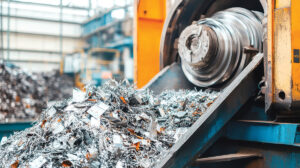

Metal shredding has long been one of the most powerful – and potentially hazardous – processes within the recycling industry. Massive rotating hammers, high-torque shafts and heavy-duty conveyors transform scrap into valuable secondary raw materials. But as the composition of waste streams evolves, so too do the risks facing operators.
Today, one of the most pressing safety challenges isn’t the machinery itself. It’s what’s hidden inside the scrap.
From lithium-ion batteries embedded in electronic devices to pressurized cylinders and hazardous waste mixed with metal, contamination has emerged as the defining safety issue for shredding facilities. According to Emily Sherman, marketing manager at Shred Station, the scale and complexity of these threats have increased dramatically over the past decade.
“The most significant safety challenge today is unforeseen contamination, with unexpected materials received,” Sherman said. “Scrap metals especially have a high risk of hidden hazards – lithium-ion batteries, unexpected hazardous waste mixed with scrap metal, pressurized cylinders, flammables, and sometimes even things like needles.”
When these materials slip into the shredding stream, the consequences can be immediate and severe. Fires, explosions, equipment damage and employee injury are all real possibilities.
“If these hazards aren’t identified before items enter the shredder, there is a real risk of injury to people and plant,” Sherman said.
Ironically, this escalation is occurring despite technological progress. Modern facilities now feature advanced fire suppression systems, better safeguards and more upstream material controls than were commonplace 10 years ago. Yet contamination levels continue to climb.
“Today, despite better technology, fire suppression systems, more thorough safeguards, and upstream material controls that maybe weren’t as commonplace 10 years ago, contamination is the highest it has ever been,” Sherman noted.
Several factors may be contributing. The overall volume of materials entering recycling streams has increased. Meanwhile, as more products incorporate batteries and electronics, even everyday items can pose unexpected hazards. Sherman also pointed to knowledge gaps at the point of disposal.
“This could be because the volume of materials being recycled is generally higher, or even because those sorting waste at customer premises may not have the level of knowledge needed to correctly identify hazardous materials and organize proper waste disposal for hazardous items,” she said.
To help address that issue, Shred Station provides awareness materials to customers, aiming to reduce contamination before materials ever reach its facilities.
The Lithium-Ion Threat
Among all contaminants, lithium-ion batteries present the most acute and rapidly growing risk.
“All batteries are a concern, but lithium-ion batteries are especially dangerous because they have a higher energy density,” Sherman explained. “If crushed or punctured, they can quickly burst into flames.”
Inside a shredder, crushing and puncturing are inevitable. The violent mechanical action that breaks down scrap metal will almost certainly damage any battery hidden within it.
“Lithium-ion fires can become very hot very quickly and, naturally, placed into a shredder, damage to batteries is essentially guaranteed,” she said.
The growing presence of batteries in recycling streams reflects broader shifts in consumer electronics and e-waste disposal. Ambarish Mitra, co-founder of Greyparrot, said facilities across the recycling sector are seeing a significant increase in battery-powered devices entering metal and mixed waste streams.
“Metal shredding facilities are seeing a surge in e-waste entering their streams, and the batteries inside those devices are quickly becoming one of the biggest safety hazards in modern recycling operations,” Mitra said. Data from Greyparrot’s waste analytics systems indicates the share of metals in residue streams at municipal recycling facilities rose from 2.5 percent to 4.3 percent last year as discarded electronics increased. “That trend means more batteries entering facilities that were never designed to safely process them.”
When a battery’s internal structure is compromised, it can trigger thermal runaway, a chemical reaction that rapidly releases heat and energy. “When a lithium battery is damaged, it can reach temperatures above 1,000 degrees Celsius,” Mitra said. “In a mixed waste stream filled with plastics, paper and other combustible materials, those conditions can quickly escalate into fires that are extremely difficult to contain.”
Compounding the danger is the environment inside many shredding facilities. Fine particulate matter, including paper dust when mixed waste is processed, can act as fuel.
“If other materials are shredded on-site, like paper, there is likely going to be paper dust in the air, which can also ignite and become out of control very quickly,” Sherman warned. “Fire suppression systems and effective dust management systems are essential for this reason.”
Lithium-ion battery fires are notoriously difficult to extinguish. They can reignite even after appearing to be under control, making rapid detection and comprehensive suppression systems critical.
When Batteries Slip Through
The problem is not hypothetical. Sherman said batteries are encountered “on a regular basis” within incoming waste streams – a reflection of broader industry-wide challenges tied to improper disposal of battery-powered devices and loose batteries.
Mitra said the scale of the challenge becomes clearer when facilities examine waste streams more closely. According to Greyparrot’s AI monitoring systems, batteries appear with surprising frequency in recycling operations.
“Our AI waste analytics systems typically detect one battery for every 2.4 tons of material at U.S. recycling facilities,” Mitra said. “That can mean roughly 11 batteries per hour on a single infeed line. When you start looking at the numbers that way, you begin to understand the scale of the risk operators are facing.”
In fixed-site facilities, the most common outcome is a minor ignition event triggered by battery rupture during shredding. “In rare cases, this can produce a small explosion and potentially ignite surrounding paper material,” Sherman said.
Fortunately, integrated fire detection and automatic suppression systems play a crucial role in limiting damage.
“All shredding equipment across our facilities is fitted with integrated fire detection and automatic fire suppression systems, which immediately deploy water to contain and extinguish any ignition,” she said. “These systems are routinely maintained and tested to ensure operational effectiveness.”
Mobile shredding operations face similar risks.
“Batteries occasionally enter our mobile shredding vehicles,” Sherman noted. “In such instances, the most common outcome is localized smoldering within the shredder unit.”
Even localized events require careful handling. “As part of our strict safety protocols, the fire brigade is contacted due to the drivers not being allowed to open the rear doors as this then adds oxygen into the smoulder,” she explained.
Across Shred Station’s operations, external fire service attendance is required approximately four to five times per year – a sobering statistic that underscores how persistent the battery challenge has become.
Continuous Prevention
For confidential shredding providers like Shred Station, safety protocols must be carefully balanced with data protection requirements. Manual sorting of customer materials is limited to avoid breaching confidentiality.
“We have implemented a range of operational controls designed to minimize the risk of batteries entering the shredding process, while maintaining the strict confidentiality standards that underpin our service,” Sherman said.
Staff training is the first line of defense. “All operational personnel are trained to recognize battery-containing devices and high-risk waste streams,” she explained.
Training emphasizes vigilance during collection and handling without compromising the confidentiality of client materials. Controlled visual inspections also play a role. While materials are not manually sorted in detail, operatives conduct proportionate visual checks at collection, unloading and before feeding material into the shredder to identify obvious non-paper items or prohibited materials.
Container design provides another safeguard. “Our containers are supplied as secure waste paper bins with restricted paper-entry slots,” Sherman said. “This design supports correct usage by limiting the insertion of larger non-paper items. And where batteries or battery-containing devices are visibly identified, they are immediately removed and segregated for compliant disposal.”
The Role of Detection Technology
As contamination becomes more prevalent, detection systems must also become more advanced. Emerging technologies – including thermal imaging, AI-powered sorting and sensor-based screening – are helping facilities identify hazards earlier and more accurately.
“Detection technologies help because they are more effective than the human eye, give early warning, and can detect a range of hazards very quickly,” Sherman said.
Artificial intelligence is playing a growing role in identifying battery-related risks within recycling streams. According to Mitra, AI waste analytics systems can be trained to recognize objects that likely contain lithium batteries and track them as materials move through a facility.
“AI systems can identify products that typically contain batteries and provide operators with far better visibility into the risks entering their systems,” Mitra said. Even when batteries are hidden inside devices, visual analytics can flag those items and alert operators before they reach critical equipment.
However, Mitra emphasized that AI is most effective when paired with complementary detection tools.
“AI alone isn’t a silver bullet,” he said. “The most effective approach combines visual AI detection with complementary technologies such as thermal imaging or X-ray sensors.”
In this layered approach, AI monitors the entire waste stream for likely battery-containing devices while secondary sensors detect concealed batteries or early signs of overheating.
“Together, these tools give operators a much clearer picture of where the risks are and how to mitigate them before they turn into fires,” Mitra said.
Thermal imaging cameras can identify hotspots that may indicate smoldering batteries before visible flames appear. Sensor arrays can detect chemical signatures associated with certain hazards. These tools don’t eliminate risk, but they provide critical seconds or minutes that can prevent a small ignition from becoming a catastrophic fire.
What Comes Next?
As electrification accelerates and battery-powered products proliferate, shredding facilities will continue to face increasing risk from embedded energy sources. Looking ahead, Sherman believes upstream solutions will be essential.
“Better upstream controls such as better labelling and disposal advice, as well as extended producer responsibility in rolling out more consistent battery take-back schemes,” she said, will be critical steps.
Stronger enforcement against improper disposal could also help reduce the number of batteries entering general waste streams. Collaboration across the industry will be equally important.
“The industry would also benefit from data sharing, with opportunities to learn from incidents and best practices used across operators, insurance providers, fire services and battery manufacturers,” Sherman said.
As industry experts emphasize, long-term solutions will depend on improvements throughout the entire recycling chain – from consumer disposal practices to advanced detection systems inside recycling plants.
by MAURA KELLER
mkeller@americanrecycler.com
Published April 2026