



by MAURA KELLER
When organic waste is landfilled, it can impact public health and the environment by releasing methane, a harmful gas that contributes to climate change. Recycling or composting organic waste releases carbon dioxide instead, which is a far less potent greenhouse gas. Because of this, municipalities across the U.S. are jumping on the proverbial composting bandwagon and creating innovative composting programs for residents and businesses alike.
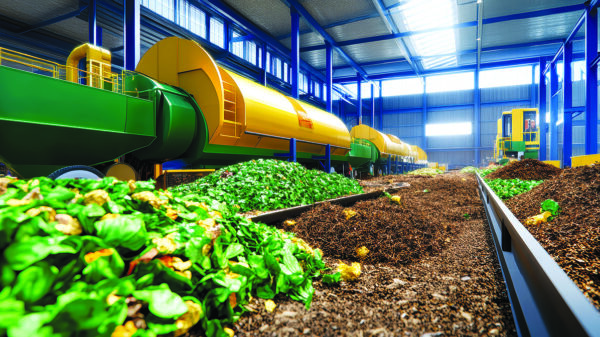
“If we look back to just 20 to 30 years ago, municipal composting programs consisted primarily of leaf and yard waste only, and they were more just ‘decomposing piles’ versus actual active aerated composting processes,” said Brian Fleury, executive vice president, North Division at Denali, the largest organic recycling company in the U.S. “These programs have become much more sophisticated as the industry and the number of feedstocks, or food waste, used to make compost, have grown.”
Today, there are still municipalities that manage their own composting operations, but many have moved to a public-private partnership (PPP) model, which means they hire companies with expertise in composting management, to operate their facility, for a variety of reasons.
As Fleury explained, most of the municipal composting operations that have gone to the PPP model have done so due to the need to have a partner to market the end-product(s), which includes compost, mulch and compost-amended soils.
“In those earlier years when participation and volumes were lower, many sites had sufficient space to store the annual volumes of incoming material and primarily used the ‘compost’ (decomposed yard waste), for their own DPW/DOT needs and also gave a good amount away for free to whoever would take it,” Fleury said. “As composting has grown in popularity, many municipalities have moved toward the PPP model, and they have seen the benefit of having professional organizations run their sites and market their finished products.”
Tim Steckel, founder of the Compost Marketing Agency, said today’s municipal composting programs typically take the form of organic waste drop-off stations, curbside pick-up and/or subsidizing backyard composting for residents.
“Opt-in programs are often used to launch a new program,” Steckel said. “It takes time to educate residents about composting and organics recycling.”
Municipal composting operations have a positive effect on job creation, as shown in a report from the Institute for Local Self-Reliance, titled “Composting makes Sense: Jobs through Composting & Compost Use (https://ilsr.org/articles/composting-sense-tables/)
For example, composting facilities in Maryland employ 4.1 full time equivalent jobs per 10,000 tons of material composted. In comparison, landfills employ 2.1 jobs and incinerators just 1.2 jobs per 10,000 tons per year.
“On a per-ton basis, composting sustains about four times more jobs than landfilling or incineration. For every $10 million invested, composting supports twice as many jobs as landfills and 17 more jobs than incinerators. And smaller composting operations create even more jobs per ton: small-scale facilities employ 13.6 jobs per 10,000 tons, medium-sized 5.9 jobs, and large sites 2.8 jobs per 10,000 tons” Steckel said. “Given that many municipalities contract their compost operation to a recycling company, these programs create lots of opportunities for recycling companies.”
The City of Arcata is a solid example of how smaller towns are initiating composting throughout their community. Arcata is a city of about 20,000 residents on California’s north coast and its eco-friendly practices are of particular importance to the municipality and community.
Given the small size of Arcata, it’s difficult to manage a composting program internally. Instead, the city partners with local organizations like Full Cycle Compost, that picks up compost from locations all throughout the community and uses special bicycle setups to bring it back to their headquarters and Local Worm Guy, which takes food scraps from homes and local businesses to feed their worms and then sell the worm manure as compost.
As the municipality of Arcata is in California, it is also subject to SB 1383, which requires organics composting for all residents. SB 1383’s goal is to reduce organics waste landfill disposal by 75 percent (from 2014 levels) by 2025. This means diverting more than 20 million tons from landfills. The legislation also aims to slow climate change by diverting organic materials from landfills, recovering 20 percent of edible food and redirecting it to food-insecure Californians.
On a larger scale, New York City currently offers curbside composting to all residents citywide. Also, NYC residents are now required to separate food scraps, food-soiled paper, or yard waste from trash. As of April 1, 2025, property owners may receive a fine if compostable material is not separated from trash.
“Composting has been very successful here in the Borough of Queens and throughout NYC,” said Queens Borough president, Donovan Richards, Jr. “Curbside composting was instituted in Queens as a pilot program in the summer of 2022. During the first three months of that pilot a total of 12.7 million pounds of compostable material was collected in Queens. The success of this pilot helped convince city officials to offer curbside composting collection citywide, and to make the separation of compostable material from other trash mandatory.”
Now that curbside composting is offered citywide, the New York City region is experiencing continued success. For example, during the week of May 18 through 24, 2025, NYC collected a record breaking 5.4 million pounds of compostable material.
“With environmental problems continuing to mount both globally and locally, we need composting programs in place and to remain in place,” Richards said. “I hope other cities follow NYC’s lead by instituting their own mandatory composting programs, and I expect that many will once they understand the environmental and cost benefits.”
Challenges of Municipal Programs
These types of contracts can be beneficial to both the municipality and the company that helps to process the waste into compost – however, Fleury said the most successful partnerships must include a win-win contractual arrangement that is viewed as a true partnership.
Another challenge Denali faces is education – the success of municipal programs hinge on business and resident participation.
“And when they don’t know that these programs exist or how to participate, they can’t and don’t,” Fleury said.
Denali provides services to collect all types of food waste for businesses such as grocery stores, food distribution centers, and food manufacturing facilities, transports it to a composting facility and transforms the unconsumable food into compost and other soil amendments.
“We have seen growth in this area as more businesses learn about this service and establish their own sustainability goals,” Fleury said. “We know that education will continue to be extremely important to the success of such programs.”
Generally, residents and business owners are fairly responsive and excited about these programs – but it takes outreach, education, and time to help business owners and residents gain interest, learn how to participate and ultimately, take action and participate.
Fleury stressed that it is important to make these programs easy to participate in as well. Overall, Fleury said interest and participation levels continue to grow. In the Northeast and West Coast, regulations to eliminate food waste have helped these programs to grow considerably and give businesses and residents more incentives to participate.
Of course, contamination is another big issue facing today’s municipal composting programs and it continues to be an ongoing challenge.
“Even in municipalities with decades-long programs, contamination happens. Up to 23 percent of the cost for operations is spent on contamination removal,” Steckel said. “Another challenge is the acceptance of compostable packaging. Every composting facility decides, based on their process and context, on whether or not they will accept these materials.”
Growth Potential
Where there are state or local regulations on green waste and food waste recycling, there is more opportunity for recycling companies to enter the market. As volume/tonnages grow for a municipality, more vehicles are required to collect and transport the organic materials to various processing technologies and facilities.
In addition, as Fleury pointed out, many cities are working to combat how much food waste reaches landfills, (which according to the USDA, is about 30 to 40 percent of our food supply today), where it emits methane as it breaks down. Methane is a greenhouse gas that is about 28 times as potent as carbon dioxide at trapping heat in the atmosphere.
“These types of programs and technologies enable cities to enhance their sustainability efforts and lean into the “green movement” (i.e., carbon/methane reduction, food waste reduction, recycling increases, etc.) which is inspiring other municipalities/cities/towns to consider similar programs,” Fleury said.
Over the last three decades, Denali has seen consistent growth with municipal composting programs, and the company expects this trend will continue.
“This growth is similar to what we experienced in the previous three decades with MRF recycling for paper, plastic, glass and aluminum,” Fleury said. “Local regulations and education play important roles in fueling the growth of this work and the ability to scale municipal composting programs. We continue to invest in education surrounding these programs, so this is just the beginning, and the more companies, residents and regulators we have on board, the stronger impact we can have.”
Published August 2025