
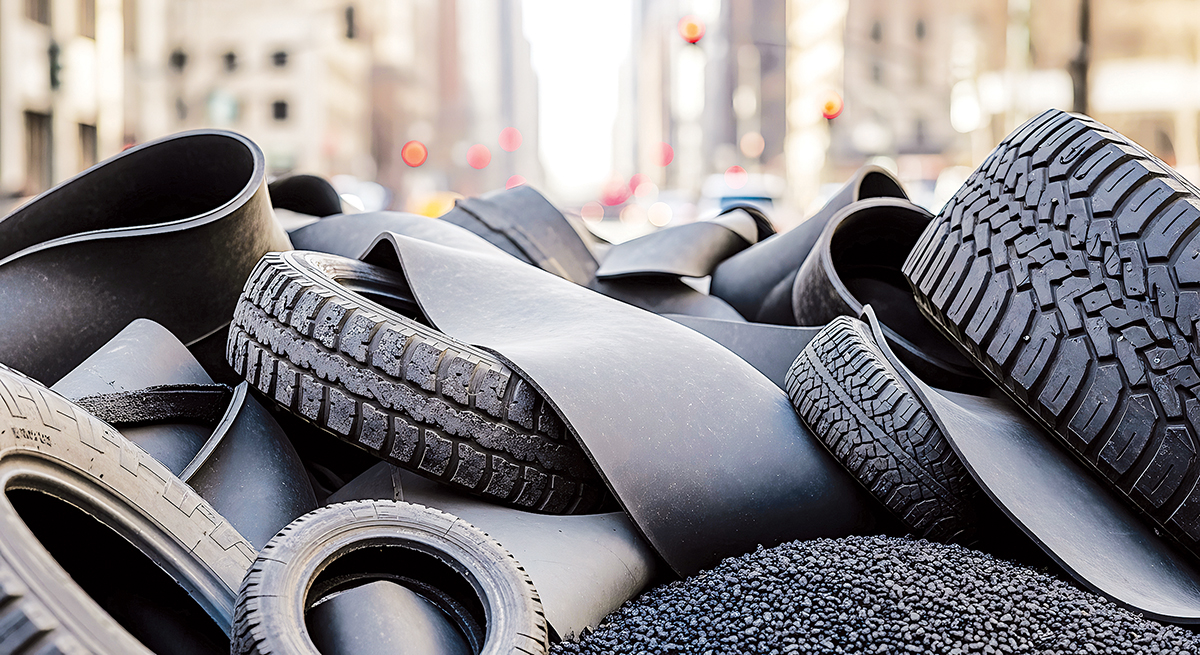
Technology is changing how recyclers, manufacturers and researchers think about rubber waste. Instead of treating it as an end-of-life material, innovations aim to restore rubber to a usable state.
For decades, rubber recycling has been defined by its limitations. Unlike metals or plastics, vulcanized rubber – used in everything from tires to industrial components – stubbornly resists efforts to be fully reclaimed and reused. The sulfur cross-links that give rubber its durability also make it extraordinarily difficult to break down and reprocess without degrading its performance. As a result, much of the industry has long relied on grinding and downcycling, turning valuable material into low-grade fillers rather than truly recovering it.
That paradigm is beginning to shift. A new generation of devulcanization technologies is changing how recyclers, manufacturers and researchers think about rubber waste. Instead of treating it as an end-of-life material, these innovations aim to restore rubber to a usable state – one that retains much of its original elasticity and structural integrity.
For recycling professionals, the implications are significant. If these technologies can scale effectively, they could unlock new value streams, improve sustainability outcomes and reshape the economics of rubber recycling. But as with any emerging technology, the path forward remains complex.
According to Priyosi Sarkar, founder of UrbanX and a sustainability and materials systems researcher, the transformation underway is not incremental – it is foundational. “Newer devulcanization methods are fundamentally changing rubber recycling by shifting it from mechanical breakdown to controlled chemical recovery,” she said.
From Breakdown to Recovery
Historically, rubber recycling is a process of reduction rather than restoration. Mechanical grinding and high-heat treatments serve as the industry standard, breaking rubber into smaller particles that can be repurposed in limited applications such as mats, playground surfaces or asphalt additives. While these methods divert material from landfills, they do little to preserve the functional properties of the rubber itself.
At the core of the challenge is vulcanization. During manufacturing, sulfur cross-links are introduced to improve strength and elasticity, effectively locking the material into a stable structure. Once formed, these bonds are notoriously difficult to reverse.
What is changing is not just the ability to break those bonds, but the precision with which it can be done. Advanced devulcanization techniques are designed to selectively break sulfur cross-links while preserving the underlying polymer chains. This distinction – breaking the right bonds without destroying the material – separates modern approaches from traditional ones.
Sarkar describes this as a defining leap forward. “This is a significant improvement over traditional grinding-based recycling, which typically results in downcycled filler materials,” she said. In this new model, the goal is no longer simply to process rubber waste, but to restore it to a state where it can re-enter manufacturing cycles with meaningful performance characteristics.
Engineering a Smarter Process
The technologies driving this shift are diverse, ranging from chemical treatments to mechanochemical systems and hybrid approaches that combine multiple methods. Each is designed to achieve the same fundamental outcome – controlled bond breaking with minimal damage to the polymer structure.
Sarkar highlights the growing sophistication of these systems. “Newer mechanochemical methods feel more engineered than brute force,” she said. “They combine controlled mechanical stress with chemical agents, so the breakdown is more even and less destructive.”
This evolution reflects a broader shift in mindset. Rather than relying on high-energy, indiscriminate processes, the industry is moving toward targeted, efficient solutions that treat rubber as a valuable resource rather than a disposable material. The result is a new class of recycled rubber with improved elasticity, strength, and usability.
Closing the Performance Gap
Despite these advances, one of the most persistent challenges remains performance. For many applications – particularly in automotive and industrial sectors – material consistency and durability are critical. While devulcanization technologies have made significant progress, the gap between recycled and virgin rubber has not been fully eliminated.
“We’re closer than we were a decade ago, but not quite at full parity yet,” Sarkar said. “The gap really depends on the application.”
In lower and mid-performance uses, recycled rubber is already proving competitive. Improved processing techniques enable materials that can replace a portion of virgin rubber without major trade-offs. “In some industrial products, it can partially replace virgin rubber without major performance trade-offs,” she said.
However, high performance applications remain more challenging. These sectors demand extremely tight tolerances and consistent molecular structures, which are difficult to achieve with variable waste streams.
“Virgin rubber still has an advantage there because it offers more predictable molecular structure and better long-term durability,” Sarkar said. The issue is no longer purely chemical – it is systemic, involving feedstock variability, contamination and processing conditions.
“The biggest issue isn’t just chemistry anymore – it’s consistency at scale,” she added.
Scaling the Technology
If the science of devulcanization is advancing, the economics of scaling it remain a critical hurdle. For recycling companies, success depends not only on technical viability but also on cost efficiency and operational reliability.
“The biggest challenges are less about whether the technology works, and more about whether it works reliably and economically at industrial scale,” Sarkar said. Many advanced processes require specialized inputs, controlled environments, or higher energy usage, all of which can increase costs.
“At lab or pilot scale, that’s manageable,” she said. “But when you move to continuous industrial production, the cost per ton often becomes difficult to compete with virgin rubber.”
Feedstock variability adds another layer of complexity. End-of-life rubber products vary widely in composition, making it difficult to achieve consistent results. “Waste rubber is highly variable, which makes it hard to achieve uniform devulcanization,” Sarkar said.
For recyclers, this means investing not only in new technologies but also in process optimization, quality control and supply chain management.
Impact and Opportunity
As devulcanization technologies improve, their potential impact on the manufacturing sector becomes increasingly clear. High quality recycled rubber offers a viable alternative to virgin materials, with implications for cost stability, supply security and sustainability.
Sarkar notes that demand is already growing, though unevenly across sectors. “Yes, but it’s happening gradually and selectively,” she said. Industries with moderate performance requirements lead adoption, while high-performance sectors remain cautious.
“The reason is simple – newer processing methods are producing material that is more consistent and closer in behavior to virgin rubber,” she said. At the same time, external pressures are accelerating interest.
“Demand is being driven more by sustainability pressure and regulatory expectations than pure cost advantage,” Sarkar added.
Environmental Impact: Toward a Circular Model
Beyond economics and performance, the shift toward advanced devulcanization carries significant environmental implications. Traditional recycling methods extend the life of rubber only once, often resulting in eventual disposal. By contrast, higher-quality recovery opens the door to multiple life cycles.
“When recycled rubber is used mainly as filler, the environmental benefit is limited,” Sarkar said. “But if devulcanization allows rubber to be reprocessed into materials that can partially replace virgin rubber, you increase the number of usable life cycles.”
Together, these advancements point toward a more circular model of material use. “It moves rubber recycling from a linear degradation model to a more circular, multi-use material system,” Sarkar said.
So, as the industry continues to evolve, collaboration, innovation and scalability determine how far these technologies can go. Advances in chemistry, process engineering, and digitalization are already shaping the next phase of development.
For an industry long constrained by the limits of its materials, devulcanization represents more than a technical breakthrough – it marks a turning point. Rubber is no longer destined to be a persistent waste challenge. Instead, it is becoming a viable, valuable resource within a more sustainable and circular economy.
“Newer chemistries are being designed to target sulfur cross-links with much higher precision,” Sarkar said, pointing to ongoing improvements in efficiency and consistency.
At the same time, the industry is beginning to rethink product design itself. “The broader trend is designing rubber products for recyclability from the start,” she said.
Palen views this evolution as part of a larger shift in how materials are valued. “We cannot afford to waste resources by downgrading them,” he said. “Recycling must focus on preserving value, not just processing waste.”
by MAURA KELLER
mkeller@americanrecycler.com
Published June 2026