


































































The increasing complexity of modern vehicles is changing which components have value, how those parts must be evaluated and what information recyclers need to provide to repairers and consumers.
The economics of collision repair are changing the path a damaged vehicle takes after an accident. As repair costs rise, vehicles that might once have been repaired are increasingly being declared total losses, creating more inventory opportunities for auto recyclers while introducing new challenges around acquisition costs, vehicle technology, parts testing and data.
For auto recyclers, the issue extends beyond the number of vehicles arriving at salvage auctions. The increasing complexity of modern vehicles is changing which components have value, how those parts must be evaluated and what information recyclers need to provide to repairers and consumers.
“Modern vehicles contain far more complex components than older vehicles, such as cameras and radar sensors,” said Luke Oswald, automotive specialist at Wheels Away. “Due to these additional complexities, it takes a mechanic more time to diagnose an issue with a modern vehicle, which increases the cost of repair.”
Greg Bunch, chief executive officer of Aspen Auto Clinic, who owns six Colorado locations and is an ASE-certified Master Technician and automotive business coach, sees the same dynamic from the repair side. Parts prices and labor rates remain important, but advanced vehicle technology has become a significant cost multiplier. A repair that once involved replacing a component may now require diagnostic scanning, programming, aiming or calibration.
“The visible damage may not look dramatically worse than it did several years ago, but safely restoring the entire vehicle is substantially more complex,” Bunch said.
In the CCC Intelligence Solutions report, “CCC Intelligent Solutions | Crash Course 2026: Complexity Compounds,” it was reported that the preliminary average total cost of a repairable claim reached $4,818 in 2025, a 1.7 percent increase from 2024. At the same time, 28.3 percent of repairable estimates included a calibration in 2025, representing roughly a 30 percent increase in the share of estimates involving that operation.
For the recycling industry, those trends matter because the higher the cost of returning a damaged vehicle to the road, the more likely the economic calculation will favor a total loss.
The economics of a total loss
A vehicle does not have to be physically impossible to repair to be declared a total loss. Insurers weigh estimated repair costs against the vehicle’s actual cash value and other expenses associated with returning it to service.
Bunch points to supplements, rental-car costs, cycle time and anticipated salvage value as additional considerations. As repair costs increase, the economic margin for repairing an older vehicle can disappear quickly.
“A vehicle can be physically repairable and still be an economic total loss,” Bunch said.
That distinction is particularly important for older vehicles, where relatively modest collision damage can represent a substantial percentage of the vehicle’s pre-loss value. Oswald noted that most vehicles on American roads are more than 12 years old, making the repair-versus-total-loss calculation especially significant when an older vehicle has relatively little market value.
More than half of vehicles now feature advanced driver assistance systems (ADAS), according to Oswald, including cameras, radar sensors, ultrasonic sensors and GPS. Even minor damage to a bumper containing ADAS equipment can result in diagnostic testing, calibration and potential hidden-damage costs.
Oswald said that more than 20 percent of claims currently result in a vehicle being totaled, as the additional expense associated with increasingly sophisticated systems pushes repair estimates higher.
CCC reported that total-loss frequency reached a record 23.1 percent of claims in 2025, according to Bunch. For recyclers, that represents a potentially significant increase in vehicles entering the salvage stream.
State regulations add another layer to the equation. Total-loss rules vary by jurisdiction, with some states using percentage-based thresholds and others applying formulas incorporating repair costs and salvage values. Insurers also have their own estimating practices.
More salvage doesn’t equal more profit
At first glance, an increase in total-loss vehicles appears to benefit auto recyclers. More vehicles entering the salvage stream can mean more engines, transmissions, body panels, lamps, wheels, electronics and other components available for resale.
“There’s lots of ways an increase in total-loss vehicles impacts the receiving salvage or recycling companies,” Oswald said. “The biggest difference is that it’ll mean there is more inventory for reusable parts for auto recyclers.”
That can expand the variety of components available, including electronics that can be resold or repurposed. But increased volume does not automatically translate into increased profitability.
“More total losses mean more potential inventory for recycled original equipment parts, rebuilders and material recovery,” Bunch said. “That can expand the supply of quality assemblies and help lower the cost of other repairs.”
The challenge is what happens between acquisition and sale. Recyclers must purchase vehicles at prices that leave room for a return, then transport, title, inspect and dismantle them, identify usable components, document their condition, store them and connect them with buyers. Auction demand can also increase acquisition costs.
“As the vehicle becomes more electronic, the recycler’s competitive advantage increasingly comes from data quality, testing, traceability, inventory systems and fulfillment rather than simply the number of vehicles in the yard,” Bunch said.
A different kind of parts inventory
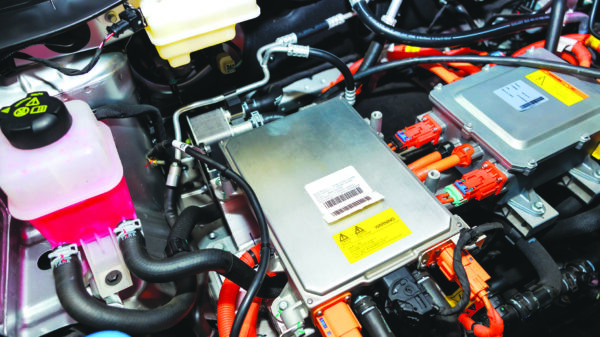
The changing composition of vehicles is also affecting what recyclers recover. Traditional mechanical and body components remain important, but modern vehicles contain an expanding collection of cameras, radar units, sensors, displays, electronic control modules, infotainment systems, lamps and power electronics.
Those parts can carry substantial value, but they also require greater scrutiny.
“It’s definitely getting more valuable, but it’s also more complex,” Oswald said. “With so much technology in each car, radar sensors and infotainment systems, for example, can hold high resale value.”
An ADAS component, however, cannot necessarily be treated like a conventional replacement part. Its application, collision history, mounting condition, software compatibility and ability to meet calibration requirements can all affect whether it can be safely reused.
“An ADAS sensor is not simply a used part with the correct connector,” Bunch said.
Testing is becoming increasingly important. Oswald said that many newer components require specialized testing and handling before they can be safely reused and resold, while failing to recover parts cleanly or allowing contamination can diminish their value.
OEM policies can further restrict reuse. Bunch points to Nissan and Infiniti, which prohibit salvaged or other secondary-market radar, camera and related ADAS components. Such restrictions directly affect what recyclers can sell and how they evaluate incoming vehicles.
Electric and hybrid vehicles present another opportunity – and another set of requirements. High-voltage batteries can represent valuable inventory, but recyclers need appropriate procedures for assessing condition, isolating batteries, handling and transporting them safely and determining whether a component has a viable second-life or recycling pathway.
“EVs, for example, require specialized handling and safe battery recovery,” Oswald said.
The emerging opportunity, therefore, is not simply to sell a part but to sell a part accompanied by reliable information about its condition and application.
“The future belongs to recyclers who can sell verified information along with the component,” Bunch said.
Recycled parts and the total-loss equation
The relationship between collision repair and auto recycling also works in the other direction. Greater use of recycled OEM parts can potentially help control repair costs and keep some vehicles below the total-loss threshold.
A recycled OEM component can offer original-equipment fit and construction at a lower price than a new OEM part. When the right component is available, the savings can make a meaningful difference in an estimate.
“The overall repair estimate can be kept lower because genuine used reconditioned OEM parts can be a lot cheaper than buying it new,” Oswald said. “In many cases this can be the deciding factor between repairing a car and writing it off.”
Bunch similarly sees recycled parts as one tool for controlling repair costs and avoiding unnecessary total losses.
“On the right repair, that cost difference can help keep the estimate below the total loss point while also returning a usable component to service instead of consuming the resources required to manufacture a new one,” he said.
However, not every component is an appropriate candidate for reuse. Structural components, restraints, one-time-use parts and certain ADAS components may be restricted by OEM procedures or lack sufficient evidence of condition and history.
Other barriers include matching parts to the exact vehicle, identifying hidden damage, grading components consistently, managing shipping and returns, providing interchange information, meeting insurer requirements and addressing warranty concerns. Oswald also points to repairer and insurer policies that may require new genuine parts in certain circumstances, along with safety concerns surrounding critical components.
Better photographs, testing information, provenance, grading systems, predictable warranties and consistent interchange data can make recycled parts easier for repairers and insurers to specify.
The consumer supply problem
The total loss trend also has implications beyond collision repair and recycling. When a vehicle is totaled, its owner needs another vehicle, and replacement options are not always easy to find.
Bunch pointed to CCC data showing that there were approximately 12 million fewer vehicles 6 years old or newer in operation as of the third quarter of 2025 than in 2020.
Oswald also pointed to another indication of the changing market – vehicles selling for less than $20,000 accounted for 55 percent of all vehicle sales in 2019, but only 31 percent in 2026. As affordable inventory becomes harder to find, consumers whose vehicles are totaled may discover that an insurance settlement based on pre-accident value does not provide enough money to purchase a comparable replacement.
Consumers may have to purchase a newer vehicle at a higher price or move into an older, higher mileage vehicle to stay within budget.
A higher total loss rate can therefore put additional pressure on an already constrained used-vehicle supply. The totaled vehicle may leave the consumer transportation pool, but its usable components can return to the market through automotive recycling, potentially helping repair other vehicles and reducing replacement-part costs.
Watching repairability
For recyclers, the future of the total loss market will depend on more than collision frequency. Bunch expects repair costs and total-loss frequency to remain structurally elevated, although several factors will influence the trajectory, including the spread of ADAS, the growing number of hybrid and electric vehicles, OEM restrictions on reused components, technician availability, calibration capacity, parts availability, used-vehicle values and salvage auction prices.
For auto recyclers, that uncertainty reinforces the importance of being prepared for both more volume and more complexity. The vehicles entering salvage may offer significant parts opportunities, but extracting that value requires sophisticated inventory management, accurate data, effective testing and a deeper understanding of increasingly electronic vehicles.
“The industry should focus on the complete economics of a safe repair rather than treating the lowest initial estimate as the goal,” Bunch said. “Better decisions made earlier can reduce supplements, cycle time, rental expense and unnecessary total losses while protecting the consumer.”
Published October 2026