










































 Glass recycling in the United States has long faced a paradox – consumers are willing to recycle glass, but the infrastructure needed to efficiently recover and reuse that material has struggled to keep pace. While glass remains one of the most recyclable materials in the waste stream, recovery rates have remained relatively stagnant for more than a decade. At the same time, evolving legislation, corporate sustainability commitments and expanding end markets are creating new opportunities to strengthen the glass recycling system.
According to Lainika Johnson, chief executive officer of TrashLogic, the challenge is not a lack of public interest but rather a system that was not designed to maximize recovery.
“Glass recycling in this country doesn’t have a caring problem. People want to do the right thing. We don’t have infrastructure that makes that easy,” Johnson said. “We’ve been stuck at 30 to 33 percent for over a decade. Switzerland and Germany are at 90 percent. Our infrastructure was never built to succeed in the first place.”
Lisa-Marie Assenza, founder and chief executive officer at Impacked, agrees that improving glass recycling rates requires addressing challenges throughout the entire value chain – from consumer collection and processing infrastructure to end-market demand.
“Expanded bottle bills and EPR are driving positive change in recycling rates in states with active policies, creating incentives for collection and end-market demand,” Assenza said.
While increasing glass-to-glass recycling remains a key industry goal, the future of recovered glass may increasingly depend on expanding alternative markets. Applications such as construction aggregate, water filtration media, abrasives and engineered materials are providing new outlets for glass that may not meet the specifications required for new containers.
“If glass can’t become a new bottle, it doesn’t have to become landfill. That’s the shift happening right now,” Johnson said.
Infrastructure hurdles
The U.S. glass recycling industry has established ambitious goals, including a target set in 2019 by producers and the Glass Packaging Institute to reach a 50 percent recycling rate by 2030. Achieving that goal will require significant improvements throughout the collection and processing chain.
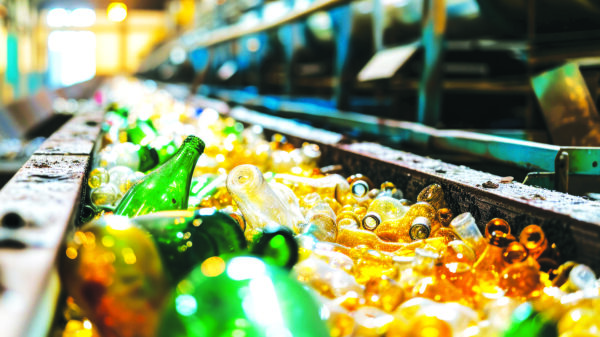
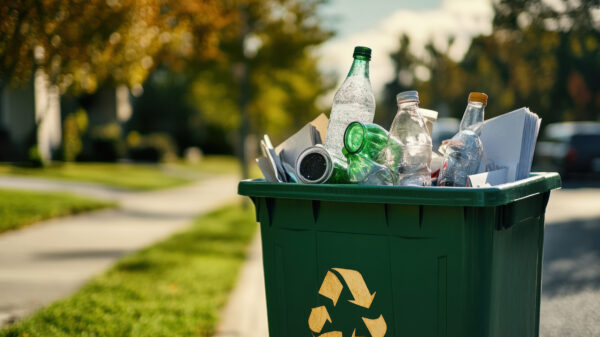
One of the biggest challenges is the continued reliance on single-stream recycling systems, where glass is collected alongside paper, plastics and other materials. While convenient for consumers, the system often damages glass before it reaches a processor, creating contamination issues and reducing the amount of material that can be recovered.
“Most people assume glass recycling is broken because people toss bottles in the wrong bin. It’s not. It’s broken because we built the wrong collection system,” Johnson said.
Single-stream collection causes glass containers to break during transportation and become mixed with other recyclables, resulting in material loss. Johnson noted that only about 40 percent of glass collected through single-stream systems is typically usable, compared with recovery rates of 90 to 98 percent from deposit-return or source-separated collection programs.
Assenza said one of the industry’s biggest opportunities is increasing the amount of clean glass entering the recycling system in the first place.
“One of the biggest challenges continues to be bringing in more glass at the top of the funnel to be recycled,” Assenza said. “This largely relies on consumers taking steps to recycle their glass, and that glass making it into the recycling process.”
Recycling participation varies significantly by state, and Assenza believes policies that make recycling easier while also encouraging consumer action can have a measurable impact.
“We’ve seen positive results in terms of increasing recycle rates from states that have implemented and expanded bottle bills in recent years,” Assenza said. “Making it easier for consumers to recycle and incentivizing them to do so are both important parts of the solution.”
New York, for example, has seen significant improvements in glass recycling rates following expansions to its bottle-return system, according to industry research. These programs help create cleaner material streams while providing a direct incentive for consumers to participate.
Building new demand
As the industry works to improve collection systems, alternative applications are helping create demand for recovered glass that cannot be returned to bottle manufacturing.
Construction markets represent one of the largest opportunities because they can use large volumes of recycled glass without requiring the same level of purity, color separation and consistency needed for new containers.
“Crushed recycled glass is replacing natural sand and gravel in asphalt, unbound pavements, concrete, pipe bedding and backfill,” Johnson said. “Some of these applications cut CO2-equivalent emissions by more than 40 percent, on top of reducing extraction costs.”
Using recycled glass as aggregate helps reduce dependence on virgin materials while diverting glass from landfills. Glass aggregate can provide performance benefits in certain construction applications while supporting broader sustainability objectives.
Foam glass aggregate is another emerging market with significant potential. Produced by processing glass into a lightweight, insulating material, foam glass can be used in applications such as backfill, drainage layers and insulation.
“Construction aggregates and foam glass are where I’d put my money,” Johnson said. “They can absorb large volumes of mixed-color, lower-purity glass – the material that fails strict color-sorting standards for new bottles.”
Beyond construction applications, water filtration is emerging as another promising market for recycled glass. Crushed glass media can serve as an alternative to traditional silica sand filtration systems in municipal, industrial and residential applications.
“Filtration media is the one I’m watching closest,” Johnson said. “Crushed glass sand is being marketed as a silica-sand replacement in municipal, industrial and residential water treatment – finer particle removal, lower biofouling, smoother surface.”
Research and industry experience have demonstrated that recycled glass filtration media can offer performance advantages in certain applications, including improved contaminant removal and reduced maintenance compared with conventional silica sand systems.
Abrasives and engineered products
Recovered glass is also finding applications in abrasive products used for surface preparation, including rust and graffiti removal. Crushed glass abrasives can replace traditional materials in blasting operations while helping divert recovered glass from disposal.
Additional end markets include fiberglass insulation, countertops, architectural tile and other engineered products. These applications provide opportunities for glass that may not meet the strict requirements of container manufacturing but still offers value as a recycled material.
“The industry stopped waiting for glass to be ‘recycling-perfect’ and started building markets around what it actually is,” Johnson said.
Advances in sorting and processing technology are helping increase the value of recycled glass by improving the quality of recovered cullet. Modern optical sorting systems can identify and remove contaminants such as ceramics, stones and porcelain while also separating plastics and other unwanted materials.
Additional technologies can help detect lead-containing glass from materials such as crystal or certain cookware, preventing contamination of recycled streams.
“The sorting technology has quietly become the most important part of this whole system,” Johnson said.
Johnson highlighted emerging dark-cullet sensor technology as a particularly promising advancement because it addresses a longstanding limitation in glass sorting.
“Before this, that material was lost entirely – the optics simply couldn’t distinguish one from the other,” she said.
Improved sorting capabilities allow processors to recover more usable glass while reducing contamination, creating stronger supply streams for both traditional and alternative markets.
However, Assenza believes technology investments must be paired with broader improvements at material recovery facilities (MRFs) and throughout the recycling infrastructure.
“The economic case for buying and selling recycled glass ultimately needs to make sense,” Assenza said. “This will require investments at the MRF level, which I see as one of the biggest challenges facing improved recycling rates.”
The future outlook
As more companies establish recycled-content commitments, the demand for reliable supplies of recovered glass continues to grow. Assenza expects expanded EPR programs to further accelerate this trend by creating financial incentives for companies to incorporate recycled materials.
“Continued expansion of EPR across the U.S. will only further this demand because it will add a financial incentive for large buyers to buy recycled glass beyond the sustainability story or optics alone,” Assenza said.
Collaboration among recyclers, manufacturers, municipalities and businesses is also strengthening recovery systems. Commercial programs that capture glass from restaurants, bars, hospitality venues and other high-volume sources can provide cleaner material streams than traditional curbside collection.
Assenza believes targeted collection strategies will be essential moving forward.
“In addition to continued legislation, expanding curbside recycling for glass and clean glass-only drop-off sites can bring more glass into the loop,” she said. “We need to take a two-pronged approach – target commercial programs and expanded legislation at places where glass waste is especially concentrated like bars, while at the same time continuing to make it easier for consumers to take action.”
She pointed to dedicated collection programs as examples of how reducing consumer friction can improve participation. TerraCycle’s partnerships with brands to collect difficult-to-recycle glass products demonstrate how targeted programs can capture material that may otherwise be lost.
One example is a nail polish bottle recycling program designed to address a challenging waste stream. Small glass containers can be difficult to capture through traditional sorting systems and are often contaminated when placed in recycling bins.
“Putting investment behind a dedicated collection program and assets educating consumers about how to clean and cure these bottles to maximize recycle readiness makes total sense,” Assenza said.
The next five years will likely determine whether the glass recycling industry can overcome long-standing infrastructure challenges while building a stronger circular economy.
Assenza believes progress will depend on continued collaboration among policymakers, brands, recyclers, processors and consumers.
“It will require real work across the value chain to make a meaningful impact,” she said. “But results so far of combining legislation with ambitious CPG company and retailer goals seem to be taking us in the right direction.”
The biggest opportunities, she believes, are improving the quality and availability of recovered glass while strengthening the economics that support processing and reuse.
“Expanding curbside recycling for glass and clean glass-only drop-off sites can bring more glass into the loop,” Assenza said. “The economic case for buying and selling recycled glass ultimately needs to make sense.”
by MAURA KELLER
mkeller@americanrecycler.com
Published September 2026