














by Matt Jones
TerraCycle originated from a university project focused on live worm composting. Although this background may imply that chief executive officer, Tom Szaky’s, motivations were purely environmental or sustainability-driven, his vision extended beyond those concerns.
“I’ve always had an interest in entrepreneurship – the idea of starting and building businesses,” Szaky told American Recycler News. “In college I really started thinking about purposeful entrepreneurship and became very interested in the weird anomalies of waste.”
Among those anomalies are how, while supply and demand curves are drawn regularly in economics, waste is the only type of material that experiences negative demand – people will pay to have it taken away. Szaky muses that everything we possess will one day become property of a garbage company.
“Yet, for how big of a point that is, it’s also the least innovative industry per dollar of revenue it enjoys, and a lot of other strange anomalies,” said Szaky.
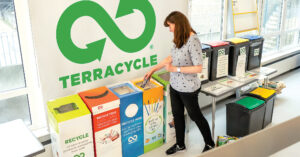
While they are produced by third parties, TerraCycle designs their own collection bins in-house.
The initial idea for the worm composting project started with marijuana. While Szaky’s friends were growing pot plants in a basement, they struggled with the ins and outs of indoor gardening. But one friend eventually solved their problems through feeding organic waste to worms to create fertilizer. While his friends may have been happy to have better-grown smoke, Szaky was struck by the concept of making a product out of garbage.
“You get paid for the input and you can get paid for the output,” explained Szaky. “Negative raw materials cost, and this started that academic exploration on waste. It also was solving the idea of how a business can be a force for good, like purposeful solutions. That’s how TerraCycle began as a worm poop company.”
Around 2001, Szaky left Princeton and started growing the company. By their third year, he started to consider an existential question about their purpose – was their goal to be a fertilizer company, or was it to solve waste? If they wanted to be a fertilizer company, they needed to focus on that and develop the very best product they could, which would mean focusing on specific types of garbage. The more he thought about it, he realized he was much more interested in making the garbage the “hero” instead of any specific product. That realization set in motion the metamorphoses of the business from a caterpillar born in worm poop to the beautiful multifaceted butterfly it is today.
The first question they asked themselves was “what really drives recyclability?” They first perceived that to be driven by technical issues, i.e., that perhaps cardboard boxes are recycled because they can be, while toothbrushes are not because we lacked the technology. But the further they dug into the topic, they realized it’s not a technological issue, but one of intrinsic economics.
“What makes a toothbrush not recyclable is that a recycler would lose money collecting and recycling it,” said Szaky. “And that’s the case for 90 to 95 percent of objects. If you zoom out to all the physical things in our lives, the vast majority are not locally recyclable. Not because they can’t be, but because they cost more to collect and process than the results are worth.”
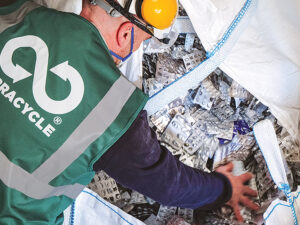
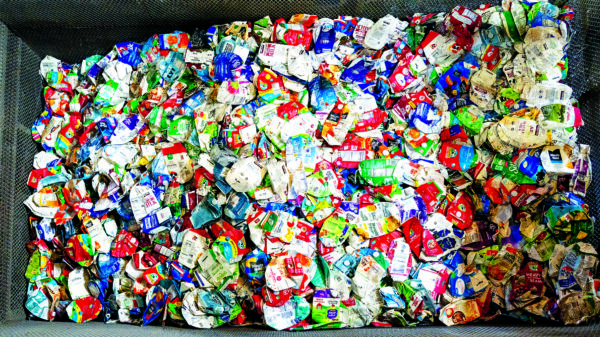
TerraCycle’s incoming waste streams – such as the load of pill packaging seen here – are incredibly pure compared to those found at a material recovery facility.
On the inverse, what makes a cardboard box or an aluminum can recyclable? That it’s profitable. Szaky notes that this points to an issue that is getting worse as time goes on – that the biggest trend in object design is cost reduction. Everyone wants things to be cheaper than they were yesterday, which makes them intrinsically less desirable to those who recover raw materials. Our waste streams are constantly becoming less valuable.
So the answer for TerraCycle was to find funding solutions – finding someone who is going to pay the bill to recycle toothbrushes or toothpaste tubes or juice pouches or plastic gloves. While there are often regulations that prevent the material from being recycled (such as gloves touching bodily fluids), it is extremely rare that the technical challenges cannot be solved – the real bottleneck has always been funding.
In terms of logistics, TerraCycle employs just under 500 people (mostly front office workers), with half of their revenue coming from operations in the United States and the other half coming from their work in 19 other countries around the world. Their supply chain has three major components – collection, sorting and processing. In some cases those are done internally, in others, externally.
A wide variety of collection bins are designed in-house and then produced at scale by fabricators. Transportation is almost always conducted by a third party, though the company does have their own fleet of vehicles. Those vehicles are predominantly parcel delivery-style trucks – never garbage trucks.
As for sorting, about 40 percent of sorting is done in-house with the rest handled by third parties. Which option is generally decided by logistics. Their facility in Aurora, Illinois, for example, is about 120,000 square feet and has significant capacity for sorting. But in other areas they have not established such large facilities.
“Our smallest sorting centers would be in our reuse division. We run the biggest reuse system in France, and there are a dozen micro sorting centers. Sorting, though, is very different than a material recovery facility (MRF). In an MRF, you have mixed waste and then either it is manually or mechanically sorted into these fractions with fast conveyor belt that movement. Our waste stream purity coming in is 98.7 percent pure to that waste stream and the sortation fraction is incredibly narrow. Most of our input is incredibly pure in that way.”
Processing is largely conducted by third parties, but there are exceptions such as lightbulb processing in their B2B division or e-waste assembly in their universal waste division. Beyond that, processing such as plastic pelletization is generally handled by third parties, but TerraCycle will invest into these companies to have them build lines for them. These investments will amount to millions of dollars annually.
A few examples of materials that TerraCycle will recycle that other companies won’t touch – latex nitrile gloves are the first that came to Szaky’s mind. Medical gloves that touched bodily fluids cannot be recycled, but that’s less than a percentage point of total plastic glove usage. Latex gloves worn by airport security officers are replaced many times a day and while the gloves cannot be effectively reconstituted into the exact same form they were, they can be used for other purposes, such as adding little bits of additional ‘grit’ to the fingertips of certain gloves to help a user grip better.
Business has been extremely good for the company in recent years – their revenue stream in the United States has almost doubled in the past five years, from $25 million to about $50 million. Szaky attributes this to both organic and inorganic growth as the company has grown itself, but they have also made a number of acquisitions in recent years, such as Connecticut-based NLR, which does lightbulb recycling.
“We’re looking for U.S.-based acquisitions. We’re looking for companies that have been around for a while, ideally a decade or two, that have demonstrated a strong track record of profitability and then focus on doing great recycling work in a very specialized category. What we’re not looking for is a curbside recycler or a generic hauler.”
As for the organic growth of the company itself, that seems driven by the multifaceted nature of the company and the many waste streams they deal with.
“It’s why we have a robust organization,” said Szaky. “It’s taken us 25 years to get here.”
Published September 2026