















by Matt Jones

Harry Hansen was driving a tow truck when the seeds for the business known today as U-Pick-It were planted. He was looking for something part time and got in the habit of hauling junk cars.
“I did that on the side and then I quit the tow truck driving job and just hauled cars,” explains Hansen. “I would haul cars for different people and some of them were in salvage yard businesses and they seemed to do well. I found a yard that was for sale and I bought it.”
In 1979, Hansen’s Truck Salvage opened in Nebraska. In 1986 Hansen launched a new endeavor known as U- Pull-It. The business focused on the same business model as U-Pick-It does today – a site where customers can come, trawl through the yard and pick out the parts they wanted on their own. Hansen admits this was not the way he had originally intended to pursue the business.
“Absolutely not,” he said emphatically. “I sold parts. Actually, I sold the parts yard to my son about 15 years ago. The U- Pull-It/U-Pick-It thing was just a different concept on part charge, but I was selling parts. The problem with the ‘you pull it/you pick it’ concept is most of the money is derived from scrap. So that’s how I got into scrap.”
Today, the business operates in five locations, across three states – U-Pull-It in Lincoln and Omaha, Nebraska, as well as Des Moines, Iowa and U-Pick-It in Prescott and Flagstaff, Arizona. There is little difference between U-Pick-It and U- Pull-It – the U-Pull-It name was simply unavailable for use in Arizona. Each site is open seven days a week and has a staff that ranges between 15 and 30, depending on the site and the number of truck drivers.
Asked about what the experience at U-Pick-It is like for a customer, Hansen explains that they pay an admission fee and are able to explore the yard for whatever part they need. If someone needs door glass, for example, all door glass runs the same price, regardless of what kind of vehicle it came from. The vehicles themselves are brought in from as many different sources as possible – including private customers, salvage pools and others. “That’s our business, we buy old cars,” added Hansen.
Upon entering the yard, visitors are encouraged to consult with staff about available vehicles – the business keeps an inventory of which vehicles are present in the yard, but not for individual parts. Wheelbarrows, carts and engine hoists are provided to assist in hauling parts at no additional charge. Basic tools such as wrenches, screwdrivers and pliers are available for loan, but bringing your own tools to remove parts is recommended. Visitors are also encouraged to bring a lubricant such as WD-40 to help coax any stuck parts, as well as a flashlight to be able to see parts in more recessed areas of the vehicle.
U-Pick-It uses Ford brand rollbacks and wreckers to pick up cars, for a specific reason – they’re the only manufacturer that builds gas powered vehicles in that class. That serves a very effective purpose for the business because they can actually salvage much of their gas from the cars that they buy. Hansen says that they used to have to pay to have the disused gas taken away, to the tune of four dollars per gallon. But since 1992, they have utilized gas powered vehicles.
“It gets rid of the gas problem and it’s also free fuel. It’s not as clean as fuel you’d buy from a gas station, but it works out well.”
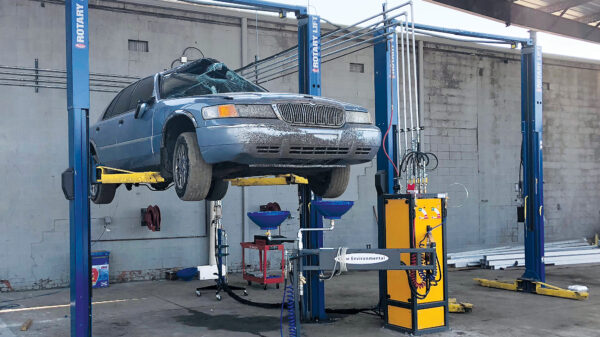
On the topic of what kind of infrastructure is required for this sort of business, Hansen cited a good drain system as crucial when dealing with junked old cars. Draining gas and oil out of vehicles ensures that those fluids don’t leak into the yard.
Another essential need for the business is an understanding of the local rules and regulations that govern the industry. As a business entity that operates in three different states, U-Pick-It must be familiar with three different sets of regulations. That being said, Hansen indicates that at a high level they are fairly similar.
“I never say ‘this is the rule, you have to do this or you have to do that,’ because every state is different. But it’s basically the same thing. You have to clean the vehicles out so you don’t pollute the ground. Each state, though, has its own requirements for how they want you to do it. There’s no hard and fast rule because every state’s different. The federal government changes laws too. We pay attention to what the laws are and make sure we follow them.”
On how the auto salvage and parts industry has changed during his career, Hansen acknowledged frankly that they used to sell more parts from older cars. Now they don’t sell nearly as much per car. In the American Recycler September “A Closer Look” column, Tom Szaky of TerraCycle indicated that a significant challenge in the general recycling industry is the fact that products are made as cheap as possible, leaving less value to be recycled. Hansen observes a somewhat different phenomenon in the auto salvage sector.
“A fuel injection part or something like that is probably worth way more than what a carburetor was back in the day,” explained Hansen. “But parts are less interchangeable and more vehicle-specific.”
Asked about the biggest challenge for U-Pick-It in 2026, Hansen cited government regulations and access to an effective labor force. But also just obtaining the cars has become more challenging as well, due to increased competition. Hansen said they do a pretty good job on getting cars overall, but it’s not quite as lucrative as it used to be.
In terms of new venues for the business, they have added shredders to one site each, in Arizona and in Nebraska. Going forward, Hansen indicated that he will keep an eye open for other opportunities to expand the business into other areas.
When asked what advice he might have for anyone looking to get into this industry, he spoke bluntly but with a laugh about the need for having love for it.
“Don’t go into this business unless it gets in your blood and you genuinely like it,” says Hansen. “I like it. A lot of the people that I know that are in this business feel the same way – once you’re in, you’re in. But it’s not for everyone. Some people make good money doing it, but they’d rather be doing something else. They don’t want to leave because it’s a good living, even if it’s not what they really enjoy. For me, though, it’s just a good business.
The people who excel in the business are those who have a passion for it, stay on top of industry developments and keep pace with changes in regulations and technology.”
“We’ve always tried to stay current with what’s happening in the industry and adopt new things because everything is changing,” Hansen said. “If you don’t like change, you might want to do something else. There’s hardly anything you can guarantee in this world, but one thing I can guarantee is that this business will change.”
Hansen has two sons involved in the industry. His oldest son works with United Auto Recyclers (formerly known as Hansen Truck Salvage Inc.) while his youngest son works with U-Pick-It.
So watch this space to see a profile about the next generation of Hansens in the auto salvage industry.
Published October 2026