








































by Matt Jones
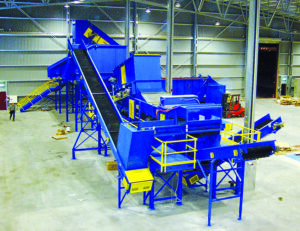
Remcon Equipment traces its roots to 1977, when it was established as a division of Idaho-based steel manufacturer REM, short for Recycling Equipment Manufacturing. The Washington based company became independent in 1991 and has since specialized in the design, fabrication and installation of conveyor-belt systems.
“Back then, REM really wanted to get into more repeatable processes and products that were more assembly line-y than what Dennis really liked doing,” said Remcon chief executive officer Sean Johnston, referring to Dennis Lux who he succeeded as chief executive officer in August. “The owner gave him the opportunity to break off and do his own thing and focus on more custom-type solutions for recyclers, so Remcon spun out of that.”
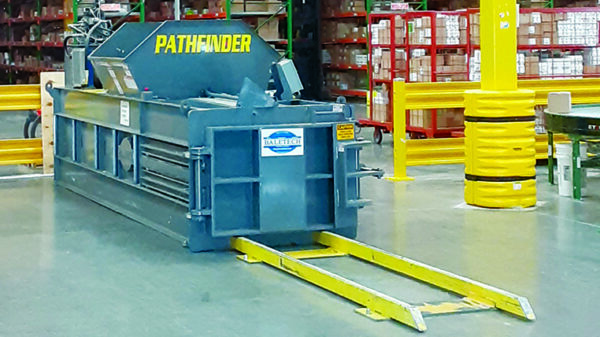
Johnston’s career has taken him everywhere from T-Mobile to tech startups. He did freelance work with Remcon before joining the company full time as chief executive officer. He separates the company’s products into two categories. About half of Remcon’s work consists of fully customized projects. A typical example is a recycling company that needs to install a baler and feed system in a facility with significant space constraints. Remcon works closely with these customers to develop solutions tailored to their operational requirements and the physical limitations of their facilities.
“The other 50 percent of what we do is a little bit more standardized,” explained Johnston. “There’s still always some custom work that needs to be done, but we do some acceleration conveyors for folks who do optical sorting. We built a system that separates plastic and glass bottles and aluminum cans into separate streams for one of our bigger customers down in Oregon. Those really are the more standardized products. I wouldn’t say they’re perfectly standardized, because Dan [Lueck], our head of engineering, is always fiddling, making them better. Every iteration needs a little bit of work trying to figure out a bit of a new design.”
Lueck, who has been with Remcon for many years, said the emergence of AI applications, including sensor systems, is beginning to revolutionize the recycling sector, much as computerized optical sorting systems did in the 1990s. For Remcon, however, the technology’s impact remains somewhat removed from its day-to-day business. “With AI, they’re doing stuff that’s even more complex than they were doing before,” said Lueck. “We’re kind of along for the ride, and still able to provide them with the basic nuts and bolts machine.”
Johnston noted that Remcon’s designs, particularly its acceleration conveyors, have evolved over the past 30 years. When the company first began manufacturing acceleration conveyors much of the fabrication – including bending, cutting, forming and hole punching – had to be done in-house. At the time, laser and water-jet cutting technologies were not nearly as advanced or widely accessible as they are today.
“There was no way to really optimize the designs as effectively as we can now, where things work with airflow better because you don’t have to design everything in a blocky fashion,” said Johnston. “You can design it more in a rounded fashion so that the air can flow more effectively and you can separate things more effectively.”
Lueck added that the technology has not only become more convenient but also more precise. Previous plasma cutting wasn’t as accurate as current laser or water-based steel cutting.
“The holes weren’t as accurate, you couldn’t trust the cuts as well,” said Lueck. “With laser cutting, we can order the parts and have our guys fit and weld them with very little effort and in any shape and configuration that we want. So that really reduced the amount of time we spend in-house making parts by hand. So we’ve really been able to increase our efficiency in the shop by utilizing some of the local suppliers that have laser cutters and CNC capabilities.”
In explaining what makes Remcon stand out compared to other businesses in the sector, Johnston said they design beds that conveyor belts ride on in a unique fashion. The company tries to build as many of their beds as they can with slats instead of just a flat piece of steel.
“That allows for less friction, and if there’s any debris that gets around the belt somehow, it can just fall through,” explained Johnston. “It doesn’t cause snags or problems with the belt or the pulleys or anything like that. It costs a little bit more for us to do it that way, there’s more welding time and that sort of thing. But in the end, it builds a much longer lasting product.”
Another unique offering is self-cleaning return pans. Lueck noted that rather than idlers that protect and hold up the belt, they have a design where the belt rides in a continuous pan and drags all the debris out into a collection point at the tail end.
“This prevents debris falling off the underside of the conveyor and making a huge mess on the floor,” said Lueck. “It’s all contained and deposited at the tail end, where they can occasionally clean it out. It’s safer, cleaner running and low maintenance.”
Material recovery facilities that do curbside or commercial collection that need retrofits on their systems make up the company’s most common customer base, Johnston noted that the company is open to working with clients outside of that sector.
“We like doing that type of work if it makes sense,” said Johnston. “We were just approached by a cement manufacturer, for example, as well as a manufacturer of a small product that needed a way to count how many units were being filled into their discharge bin. It’s kind of a unique proposition. They need it mobile, on the back of a trailer or a truck. We like going through those engineering iterations and helping the customer actually solve the problem. That’s about 10 to 20 percent of our business. The other eighty percent is for material recycling facilities.”
Remcon’s market is far reaching. Most of their work takes place in the U.S. and Canada, but they have sold some systems to clients as far away as Japan and Australia through partner businesses.
Johnston said that most of Remcon’s business, about 80 percent, is repeat customers. One of his goals as chief executive officer is to expand the horizons of who they sell to – both within and beyond the recycling sector.
“I think Dan and Dennis have done an absolutely phenomenal job engineering and designing these systems and building an incredible product,” said Johnston. “That’s where their bread and butter is and I see the opportunity here. They’ve built this baseline of really good products that seems like they last forever, especially when we hear stories about some of our competitors. We’re expanding who we sell these things to because there’s a huge untapped market throughout the States that I think we can approach.”
Johnston sees that as a two-pronged approach. On one hand there are partnerships – the company has some partner businesses that they work with, and he would like to expand on that. A possible example he cites would be businesses that produce equipment for MRF operations that Remcon can’t or won’t build.
“Things like eddy current separators – we don’t build anything like that, that’s above our pay grade and we don’t want to build those,” said Johnston. “We want to partner with the best folks in the industry who do that.”
The biggest challenge for Remcon is finding a way to share all the knowledge that their long-term employees have amassed.
“Dan is a major bottleneck,” said Johnston, referring to Lueck’s 22 years with the company. “He and Dennis know about as much as you can know about the market and about manufacturing for particular customers. So I think getting somebody up to speed, perhaps a junior engineer, is going to be a challenge. To get them to have the full breadth of tribal knowledge that was developed over those 22 years and beyond are the sort of operational challenges that I’m trying to attack right now.”
“Dennis and I have been here forever and that was one of the things we struggle with,” added Lueck. “How do we take the next step in growth? We are so busy dealing with the day-to-day and taking care of our customers, so it’s hard to reach more customers. That’s what we know Sean can do. He’s been doing a great job expanding contacts and building relationships with people so we can sell more products and help more customers.”
Published November 2026